Showing posts with label transformation. Show all posts
Tuesday, April 11, 2017
A cure for Parkinson's? Replacing damaged brain cells shows promise
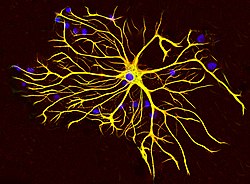
This article is about a new technique that has hopes of improving Parkinson's disease. This disease involves a lower number of dopamine being introduced into the system, which causes the physical tremors and decreased sense of balance in the individual. The new technique is to transform non-dopamine producing brain cells into brain cells that can produce the chemical. This is being done by changing the astrocytes cells (the cell in the picture above) to replace the damaged dopamine cells. This process was tested on mice and the results were successful. My opinion on this is that this is a good step in the right direction. In the article it mentions that this technique needs to be developed further if going to be applied to humans. I completely agree with that and am hopeful that this can become available for human patients sooner rather than later.
Medical News Today
Parkinson's Disease
Saturday, November 8, 2014
Using Fibroblasts to Create New Blood Vessels
Cardiovascular researchers at Houston Methodist have learned that they can use fibroblast cells and convert them into endothelial cells which will create blood vessels. Fibroblasts are the cells that cause scar tissue and are abundant in the human body. John Cooke, the study's main researcher, says that this is the first time that small molecules and proteins have been converted into a therapeutic cell type. Cook's hope for this discovery is that it will be used to improve the healing of cardiovascular injuries and other injuries throughout the body that require an increase in circulation.There have already been studies done that use viruses to transform cells into those need in the body, but there are limitations and many risks that go along with this form of transformation. It is believed that using small molecules and proteins will be more safe for use.
The new method and Cook and his other researchers proposed involves exposing the fibroblasts to poly I:C (polyinosinic:polycytidylic acid) that will cause the cells to think that they are being attacked by a virus. Poly I:C is a small segment of RNA that binds to the host cell receptor TLR3. This viral attack caused the fibroblast cells to reorganize their nuclear chromatin, which allowed genes that had previously been blocked off to be expressed. Factors, such as VEGF, were the applied to the fibroblasts because these factors are known to cause certain cells to convert into endothelial cells. This treatment caused 2% of all the fibroblasts in the body to be transformed into endothelial cells, the same percentage outcome as using a virus to transform the cells. Cooke claims that he has unpublished work that shows that up to 15% of the fibroblasts can be converted using his method.
In order to prove the effectiveness of the new cells, Cooke injected the cells into mice that had the need for new blood vessels in their hind limbs for circulation. Once the cells were introduced to the mice, the blood vessel number increased in the hind limbs and blood flow was improved. Cooke believes that his findings will pave the way for more studies to continue and possibly lead to finding ways to regenerate mass amounts of damaged tissue in humans.
This is a very interesting study that goes to show that there are many different ways to manipulate the cells of the human body, and as our knowledge of genetics continues to grow, many more interesting findings like this will occur.
Original Article: Reprogrammed cells grow into new blood vessels
| The top picture shows fibroblasts stained blue, and the bottom picture shows the amount of fibroblasts that transformed into endothelial cells after treatment with poly I:C and VEGF |
The new method and Cook and his other researchers proposed involves exposing the fibroblasts to poly I:C (polyinosinic:polycytidylic acid) that will cause the cells to think that they are being attacked by a virus. Poly I:C is a small segment of RNA that binds to the host cell receptor TLR3. This viral attack caused the fibroblast cells to reorganize their nuclear chromatin, which allowed genes that had previously been blocked off to be expressed. Factors, such as VEGF, were the applied to the fibroblasts because these factors are known to cause certain cells to convert into endothelial cells. This treatment caused 2% of all the fibroblasts in the body to be transformed into endothelial cells, the same percentage outcome as using a virus to transform the cells. Cooke claims that he has unpublished work that shows that up to 15% of the fibroblasts can be converted using his method.
In order to prove the effectiveness of the new cells, Cooke injected the cells into mice that had the need for new blood vessels in their hind limbs for circulation. Once the cells were introduced to the mice, the blood vessel number increased in the hind limbs and blood flow was improved. Cooke believes that his findings will pave the way for more studies to continue and possibly lead to finding ways to regenerate mass amounts of damaged tissue in humans.
This is a very interesting study that goes to show that there are many different ways to manipulate the cells of the human body, and as our knowledge of genetics continues to grow, many more interesting findings like this will occur.
Original Article: Reprogrammed cells grow into new blood vessels
Subscribe to:
Posts (Atom)