Showing posts with label phylogenetics. Show all posts

Monday, November 20, 2023

Where Do Oranges And Lemons Originally Come From?

Gayle Volk, a plant physiologist at the U.S. Department of Agriculture describes citrus as "fascinating" due to many of the crops processed through hybridization. Citruses have a huge genetic diversity, unlike any other fruit. This recent research has opened up the exploration of the citruses' evolutionary journey. They analyze the genomes of numerous citruses and then study the uncovered insights into the origin of these fruits. Recent hypotheses have stated the origin of citruses was from the Himalayas to northeastern Australia, but after further study, they figured out they originated from south-central China.

The research team at the Huazong Agricultural University in China assembled genomes from a dozen species and compared them with existing genetic records. This then led to them making a phylogenetic tree, and an evolutionary tree, these provided good information on the origin of where they are from. The trees also revealed that citrus plants emerged over 25 million years ago. Mandarins and trifoliate oranges began evolving in south-central China, and other citruses such as pomelo and citron evolved slightly later.

Understanding the genetic origins of citrus has significant implications for their preservation and conservation during environmental challenges such as pests and diseases. Gayle Volk emphasizes the importance of refining the genetic origins for effective conservation. Overall, this genetic study offers us a good glimpse into the complex history of citrus fruits. It shows not just their evolutionary journey but also the critical role genetics play in shaping their flavors and looks. 

Articles: 

Sci Am Article

Evolution in the Citruses

Thursday, November 9, 2023

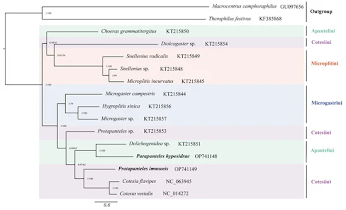
Phylogenetics in two parasitoid wasps


The mitochondrial genomes of Parapanteles hypsidrae and Protapanteles immunis are sequenced and annotated revealing two novel types of gene rearrangement, the local inversion of nad4L in Pa. hyposidrae and the remote inversion of the block cox3-nad3-nad5-nad4 in Pr. immunis, within the mitogenomes of Braconidae. This study conducted analyses of base composition, codon usage, gene rearrangement, and phylogeny within Braconidae (the family that both of these parasitoid wasps belong to). The results of this analysis suggest that the sub family, Microgastrinae, is a monophyletic group despite Apantelini and Cotesiini, the tribes within the subfamily, both being paraphyletic. This article breaks down the genetic research being done to connect different species through the evolution of their genetic code from the most recent common ancestor and comparing their expressed traits.

This article’s focus on tracking the genetic connections between these wasps, using phylogenetics, is very interesting to me. The particular mutations found in their genomes illustrate their close relationship, as well as establishing a possible monophyletic sub family, which contains two paraphyletic tribes. Comparisons like these can further our understanding of the connections between species through their shared or derived traits.


Wednesday, November 1, 2023

Horseshoe Crabs, Spider Cousins or Something Else?

Horseshoe Crabs represent a long and proud lineage of chelicerate arthropods. Famed for their role as survivors, the order Xiphosura (fancy word for horseshoe crabs) can trace their fossil record back to the Ordovician Period some 445 million years ago. A once diverse lineage of animals, today xiphosura is represented solely by the Atlantic Horseshoe Crab Limulus polyphemus. Traditionally it has been hard to place the Horseshoe Crab into the evolutionary tree of life. Many studies have concluded that the Horseshoe Crab is a distant relative of arachnids. However many of these studies were going in with a biased assumption, arachnids are a monophyletic group of organisms. 


An Atlantic Horseshoe Crab

In evolutionary biology, phylogenies are created using various datasets to reconstruct the evolutionary relationships between different organisms. When a selected group of organisms can trace their heritage back to a common ancestor, we call this group monophyletic. A good example of a monophyletic  group is the Primate Order. All living primates share a common ancestor as consistently indicated by both fossil/morphological datasets as well as genetic datasets and are therefore a monophyletic group of organisms. Things can get messy with recovering the phylogenies of organisms with broad and unclear relationships that originated deep in time. Such is the case with chelicerates.


Simplified Taxonomy of Tetrapods 
Note: You are indeed a fish, no disrespect

You and I are both fish, in a taxonomic sense, as are all terrestrial vertebrates. We can trace our ancestry back to boney fishes in the Devonian and many features we take for granted, such as our ears and Adams-apple are highly derived gill ridges. Obviously though, when I tell you that I'm going to spend a weekend fishing, you the reader aren't confused by evolutionary semantics and envision a set group of animals. Perhaps if I say I'm fishing at a lake, you the reader would envision me reeling in a trout or pike. If I say I'm going to fish at sea perhaps you the reader envision me reeling in a tuna or a shark. You don't however, envision me catching an elephant nor a kangaroo when I say "I'm going fishing" despite both organisms being *fish* in the evolutionary sense as their ancestry is ultimately bound to the water. The same applies for reptiles, most people generally view reptiles and birds as separate categories of organisms. This division between birds and reptiles falls apart when one considers that birds are dinosaurs and dinosaurs are clearly reptiles. Paraphyly refers to when  a large group of animals are given a name/rank but selected subgroups are omitted due to differences in bodyplan or ecological habit. So whenever you call something a "fish" but are failing to include every other terrestrial vertebrate in your referral, you are being what taxonomists call "paraphyletic". 


Simplified Taxonomy of Birds
Note: Crocodilians are the closest living relatives of birds

Chelicerates should be defined before we go any further as things could get confusing quickly. Today the chelicerates include the following; mites, spiders, sea spiders, harvestmen, scorpions, pseudoscorpions, camel spiders, whip scorpions.... You get the point. The exact relationships between the sub-categories of the chelicerates is a bit messy, it was long assumed that chelicerates include a monophyletic "arachnid" sub-group with xiphosura being its sister out-group clade. Genetics has brought into question that assumption. Most morphological studies recovered a monophyletic arachnid group with a sister monophyletic Xiphosura clade. 

Genetic analytical work by Ballesteros et al. has shown however that many of the "arachnid" groups are are not related closely to one another and are instead convergent. More interestingly the study found Xiphosura to be nested smack-dab between Opiliones (harvestmen/daddy longlegs) and Pseudoscorpions both of which are traditionally considered arachnids. This result is interesting as it implies that the traditional definition of "arachnids" is a paraphyly. To recover arachnids as a true monophyly, the definition would need to be expanded to include  Xiphosura, meaning that Horseshoe Crabs are arachnids. 


Phylogenetic tree from Ballesteros et al. 


Friday, April 15, 2022

Insight Into the Evolutionary History and Phylogenetic Relationships of Deep Sea Asteroidea Using Mitogenomics


        Mitogenomics is the the the sequencing and analysis of mitochondrial DNA. The majority of mitochondrial DNA comes from maternal descent, is relatively small, and has a high nucleotide substitution mutation rate. allowing researchers to better understand the evolutionary history and phylogenetic relationships of a particular organism.
        Sun et al. use this technique to study the geographic origin and relationships between shallow water and deep-sea Asteroidea. For their experiment, they selected five deep-sea genomes. It showed that deep-sea Asteroidea had a much higher A+T nucleotide content compared to those in shallow water, providing insight into the divergence of base composition. Studying the genome also allowed researchers to identify the sequences responsible for the deep-sea adaptations against cold temperatures and hydrostatic pressure.
        By comparing sequences of different Asteroidea with each other and seeing when new mutations arose and for how long they were passed on, the origin of each mutation could be speculated. The more matches in DNA, the closer the relationship. Using this information, it was speculated that during the Triassic-Jurassic transition marked by a mass extinction event, the rapid divergence between the deep and shallow water varieties occurred to fill in the newly opened niches. Although it was inconclusive, the results also pointed towards a deep-sea ancestral origin.
        It is important to understand the evolutionary history and evolutionary mechanisms of organisms since it helps us understand why a species may exist in a certain environment and how the world as we know it today came to be. It is also important to compare the survival mechanisms of different organisms because it can help with cultivation for commercial purposes or conservation efforts.


What to read next: Global Diversity and Phylogeny of the Asteroidea (Echinodermata)


Wednesday, November 24, 2021

Genome Spotlight: California Sea Gooseberry (Hormiphora californensis)


\
This article deals with how many biologists and scientists debate whether organisms like the ctenophore or the sponge came first. Recently a chromosome-level ctenophore genome shows that comparing whole chromosomes can "resolve the phylogenetic position of ctenophores and sponges". The fact that sponges do not really have true tissues, organs, or symmetry makes it believable that they were more ancient, but many researchers have claimed that their genomic research on ctenophores proves otherwise.
Chromosomal level evidence of ctenophores is now being examined by culturing the California Sea Gooseberry in order to produce the first karyotype  for them. It was found that they have 13 pairs of chromosomes. The researchers then used Hi-C chromatin conformation capture to visualize the chromosomes microscopically. In the genome they found thousands of nested intronic genes, many of which were doubled nested. Since this is found in plants, animals, and even humans, it suggests that the genes found in these organisms may have evolved over time. While this research did not focus on the comparison between sponges and ctenophores specifically, it shows that the methods needed to uncover that debate can be performed.