Showing posts with label phospholipids. Show all posts

Wednesday, November 16, 2016

Ferroptosis, Iron Controlled Cellular Death


https://www.sciencedaily.com/releases/2016/11/161114110708.htm

The way a humans have gone through controlled cellular death has been a mystery for year and has eluded the hand of scientist for years. Control cellular death is particularly important because it can help cure many diseases like cancer and radition sickness. There are a number of way a cell can do this usally it needs the help of the body and other molecules in order to properly regulate the disposale of the damaged cell. Ferroptosis is different than apoptosis, a more commonly know form of cell death, is that the ferroptosis pathway uses iron in order to catalyze a reaction that safely removes or recycles the damaged cellular material. (Helmholtz). Decoding the signals that facilate this pathway can help answer many questions about controlled cellular death. An international team of scientists head by the University of Pittsburgh have thought ton have mapped the ferroptosis pathway. Their findings were published in two papers published in Nature Chemical Biology, their work can be used to develop treatmeants for many different types of illinesses.
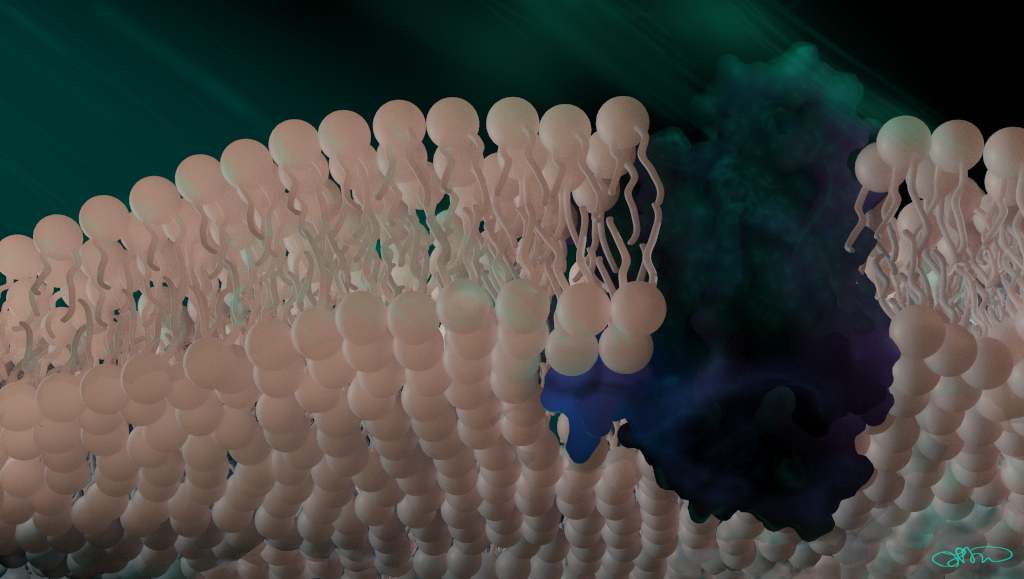
 They found that there are four phospolipid molecules that signal to the body rest of the body that the cell they are around is damaged and needs to be properly taken care of. A phospholipid is a molecule with phosphate head with a lipid tail, it is commonly found throught out the body. Phospholipids are the molecules that make up the majority of cell membranes, the picture above is depiction of a cell membrane. A lead member of the team Professor Kagan says, "Scientists have long known that these lipids were important for encasing the cell and giving it structure... What they didn't know is that they do so much more, including communicating and signaling messages like 'danger' inside the cell itself, to other cells and to the cellular community as a whole, so that organisms can function in a coordinated way." (UPMC). Their findings have also suggested that ferroptosis can be used to treat the underlying cell that cause radiation sickness. Althought apoptosis has already been decoded every controlled cellular death pathway is different and every new decoded pathway can help uncover why certain pathways are not working. Certain pathways are also used in certain types of cells, apoptosis is not the path choosen everytime in every sitituation. Figuring out what pathway is used at what time and to what cells are the focus on is the next medical breakthrough that will help treat and cure many terrrible dieases.


Helmholtz Zentrum Muenchen - German Research Centre for Environmental Health. (2016, November 15). Cancer research: How cells die by ferroptosis. ScienceDaily. Retrieved November 16, 2016 from www.sciencedaily.com/releases/2016/11/161115083915.htm

 University of Pittsburgh Medical Center (UPMC). (2016, November 14). International team decodes cellular death signals. ScienceDaily. Retrieved November 15, 2016 from www.sciencedaily.com/releases/2016/11/161114110708.htm

Monday, November 3, 2014

A team of research students Lead by Dr Neal Devaraj, a chemistry and biochemistry professor at UC San Diego, discovered that a self-driven reaction can assemble phospholipid membranes like those that enclose cells. This discovery is very important when studying artificial cells.


Dr. Devaraj reports "This is the first report to my knowledge of nonenzymatically forming phospholipid membranes from thioester precursors.This mimics the membrane-protein-catalyzed assembly of phospholipids in live cells, which also uses long-chain thioesters as precursors."

As known, All living cells use membranes. The membranes are used to control the movement of biomolecules in and out of the cell. Biomolecules that send signals to and from the cells being the most important.
The team at US San Diego discovered and developed new reactions that can trigger the formation of membranes. Specifically the spheres that characterize membranes that enclose vesicles and cells. They described the process as specific and non-toxic. It is to be used in the presence of biomolecules within artificial cells. As said in the article, the technique could also be used to assemble packets for drug delivery.
Using thioester precursors, all natural cells use enzymes to catalyze the biochemical reactions that manufacture their membranes. However, the team At UC San Diego was able to get membranes to assemble spontaneously, without the use of any enzymes. They were able to accomplish this through a process called native chemical ligation.
This breakthrough in cell membranes will help further in the studies of artificial cells. Because the use of enzymes isn't necessary in the new process, the reactions appear to be "spontaneous." This spontaneous reaction using ligation allows for the chemical chains to bond together, such as DNA or protein, and create a new membrane.