Showing posts with label genotypes. Show all posts

Thursday, November 23, 2023

The Underappreciated Genetic Footprint That Can Resolve Participation Bias

     No one can achieve perfection. A main issue faced in research studies is predominantly impacted by sampling bias, resulting in skewed results. In Genetic studies, participants and data are collected from genetic databases. As useful as the genetic database is, one problem arises. Most primarily ascertainment bias, in other words, genetic data collected does not accurately encompass the intended study population. This curiosity was credited to Oxford's Leverhulme Centre for Demographic Science and Big Data Institute, which conducted a study to understand why certain individuals stand out in the database. Using the largest biomedical databases. The UK Biobank brought attention to a genetic footprint left on ascertained genotypes, that corresponds to the trait of probability of participation of participants. Sounds like an easy fix for participation bias. Although evidence in alleles that are common in genetic segments of participants suggests correlation to the percentage of participants participating in studies. However, it is still difficult to compare genetic information of participation with nonparticipants directly. In theory, taking note of the variety of participant behavior, and health traits could improve analyses of the study data. Research is ever evolving to fully understand the main question. What is a gene?

Links:

https://www.ox.ac.uk/news/2023-07-13-participating-genetic-studies-your-genes-oxford-study

https://www.nature.com/articles/s41588-023-01439-2


Monday, April 5, 2021

Reunited Ravens Genotypes were once individual lineages

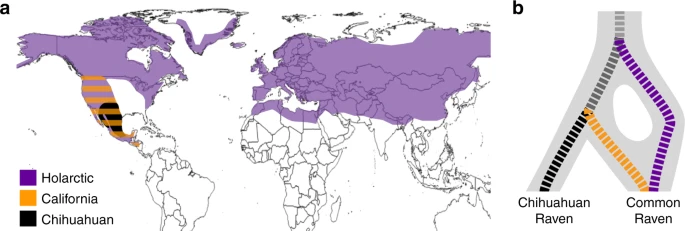
 In this article, the species of the holoarctic(common) raven, the Californian raven and the Chihuahuan raven were hypothesized to have been more separated in genotype in the past. Scientists have studied the ravens' mitochondrial DNA, one of the nuclear introns on the Z chromosome, several autosomal introns and genome-wide SNPs and mapped out how much was shared between the species. Combined with the ecological niches of the current day ravens and behaviors, a comparison of the shared genetic material was made between all of the birds.

For the mitochondrial DNA, it showed that the holoarctic and the Californian ravens shared mtDNA but only what is currently in the northwestern US. But the Z nuclear intron did shed a light on the paraphyletic branches of the holoarctic and the Californian ravens. The Chihuahuan raven split off earlier to speciate. Taking over a period of a million years, the ravens were once their own species with the holoarctic and the Californian lines converging into a single lineage, and from tens of thousands of years and hybridized.


This also would shed light on how humans came to be. Since speciation reversal is still evident in the Homo sapiens genotype. With bits of Neanderthal and Denosovian DNA in our genotype, there could have been hybridization between differing homind groups and that the parts were swapped over eons of randomized mating.