Showing posts with label bonobos. Show all posts

Saturday, November 12, 2016

Interbreeding Between Cousins Calls for a New Study


Two different species of apes interbred to create a new study. Researchers found that chimpanzees and bonobos became different species about two million years, but DNA found in chimpanzees proves that the two species have mated and produced offspring together. This did not only happen once but two times in the past 500,000 years. Around 350,000-500,000 years ago chimps and bonobos were suggested to come together and again about 150,000 years ago. According to another journal, these researchers were not the first to find these results in DNA research with the chimpanzees. The researchers compared this interbreeding to humans mating with Neanderthals and other possible species that could have existed thousands of years ago. Neanderthals DNA is found in humans just like the apes.

I find this so interesting because I feel as if both species do not see a large difference between each other. I believe that animals are very intelligent, especially apes. They are distant cousins, but it is odd that they have only seemed to mate at two different times. It makes me wonder why it occurred when it did and why did it not happen again. The researchers mentioned that the bonobo DNA in a chimp was actually more negative rather than a positive, for a biological standpoint I would not know much about it, but for research I find it quite awesome. Hopefully more studies are conducted to find if more species did interbreed and to also find out why mixing these two species is so negative.
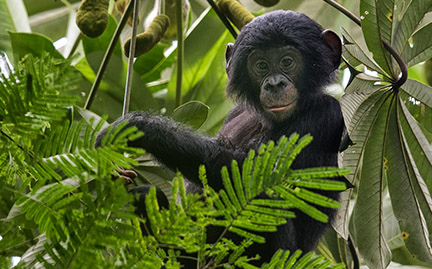
Thursday, November 3, 2016

Genome Sequencing of Chimpanzees and Bonobos reveals Unexpected Ancient History


Chimpanzees and bonobos, humans closest relatives, are thought by scientists to have an ancient history of gene mixing, showing parallels with Neanderthal mixing in human ancestry. Studies have shown that 1% of chimpanzee gnomons are derived from bonobos. It also showed that genomics can help determine individual chimpanzees country of origin, which can contribute to chimpanzee conservation. Both species are endangered and are supposedly fully protected by law, however many chimpanzees are captured and held illegally.

Researchers analyzed the genome sequences for 75 chimpanzees and bonobos from 10 african countries as well as 40 wild-born chimpanzees from unknown locations. The results proved that the chimpanzees genome sequence depended on their geographic location.

Chimpanzees and bonobos derived from a common ancestor between 1.5 and 2 million years ago. Since the species are separated by the Congo river now, it was thought that gene flow between the species was impossible. The study found that some individuals would have had to cross the river because there were two gene flows events between chimpanzee and bonobos.

The study also included results that showed that there were two phases of secondary contact. One occurred 200-500 thousand years ago and the other occurred 150 thousand years ago.These events are believed to have happened during the last 100 thousand years of human evolution.

This is the first study to be conducted that provides finding in gene flow events in species closest to humans.

This is a riveting article that humans deeper into their ancestry. Sequencing the genomes can explain the specific chimpanzee's geographic origin. This is important because it can lead to more knowledge pertaining to how they can be conserved since they need more then laws to be protected. It's astonishing to think of the impact gene flow can have. This one in particular influenced the genes of both chimpanzees and humans. Something that scientists thought to be impossible actually wasn't so impossible after all.


Friday, October 28, 2016

Chimps and bonobos had flings—and swapped genes—in the past

There has been a lot of evidence in recent years of species that have interbred with closely related species in their past.  A study was performed in order to compare the genomes of chimpanzees and bonobos in Africa in order to determine their evolutionary relationship.  Chimps and bonobos are closely related species that fall into the Great Apes group that humans are also a part of. This study was started due to the findings in 2010 that humans and Neandertals actually interbred in the past, causing genes to be shared and passed between species.
Picture of African Chimpanzee
Chimps and bonobos in Africa are mostly separated by the Congo River, so these species don't interact very often.  The Congo River may be a large factor that led to the speciation and split of these two animals and caused them to evolve independently.  However, genome tests concluded that the chimps actually had 1% of bonobo DNA in them.  This led the scientists to conclude that these two species had two separate interbreeding events in the past that led to the shared DNA.  These findings along with the discovery of Neandertal DNA in humans is helping to change the classical definition of a species.  More and more evidence has been showing that different species can in fact interbreeed to produce fertile offspring, and is changing the way that evolutionary relationships are being viewed between species.