Showing posts with label "liver". Show all posts

Sunday, October 6, 2024

Gene Therapy Infusions for Hemophilia B Patients

Recently, Penn Medicine published an article discussing how in the third phase clinical trial of an international study, adults with hemophilia B who received a single infusion of gene therapy saw a 71% decrease in the number of bleeding episodes. 


Hemophilia is a type of genetic disorder that slows the blood's clotting capabilities, which in turn causes spontaneous bleeding into critical areas such as joints. More specifically, hemophilia B is a type of hemophilia where clotting factor IX is not produced enough, so gene therapy is used to start the creation of clotting factor IX in the liver.


What the study showed was days after a patient's first infusion their body started to create clotting factor IX and after a year patients had a 71% reduction in spontaneous bleeding. On top of this over 45% of patients reported not having any bleeding after gene therapy. However, the most common adversive side effect of this was an immune system attack on liver cells, which can potentially be stopped with steroid treatment. The study is expected to continue for a minimum of five total years to observe all side effects, both long and short-term.


While this breakthrough could be critical for treating patients diagnosed with hemophilia B, it is important that the study continues to monitor all side effects before making this form of treatment widespread. This study as a whole is not only impressive for genetic medicine, but could be a breakthrough in treating a plethora of other diseases that have no known treatment as of now.


https://www.pennmedicine.org/news/news-releases/2024/september/gene-therapy-is-potentially-life-changing-for-hemophilia-b

https://www.pennmedicine.org/for-patients-and-visitors/patient-information/conditions-treated-a-to-z/hemophilia

https://www.pennmedicine.org/research-at-penn/gene-therapy

Thursday, March 21, 2019

Guided by CRISPR, prenatal gene editing shows proof-of-concept in treating disease before birth


In an article from Science Daily, scientists conducted gene editing to prevent a lethal liver disease in laboratory animals and offers to treat human congenital disease before birth. Researchers from Children's Hospital of Philadelphia used low-toxic DNA base editing tools to turn off the effects of a disease causing genetic mutation. In this study, scientists performed prenatal gene editing to improve liver function and to prevent neonatal death in a group of mice that had been engineered with a mutation causing the lethal disease called hereditary tyrosinemia type 1 (HT1). In humans, HT1 usually occurs during infancy and treated with a medicine called nitisinone and strict diet. But, when the treatment fails the patients are in severe risk of liver failure or cancer. Scientists suggested that prenatal gene editing can be used to prevent disease like HT1 and many other congenital diseases. The research used base editor 3 (BE3) and a modified CRISPR associated with protein 9 (CRISPR-Cas 9) tool to carry an enzyme to a particular genetic location in the liver cells of the fetal mice. The enzyme modified the targeted genetic sequence of liver cells chemically by changing the type of DNA bases into another. As a result, the mice showed reduced level of cholesterol and had improved liver function.

A future application for DNA base editing could be correcting disease-causing mutations and to improve functions of organs beyond liver. I think this technique would be very useful for doctors to treat diseases during early pregnancy to ensure the health of the fetus.

Monday, September 18, 2017

Does COPD have a Genetic Component?


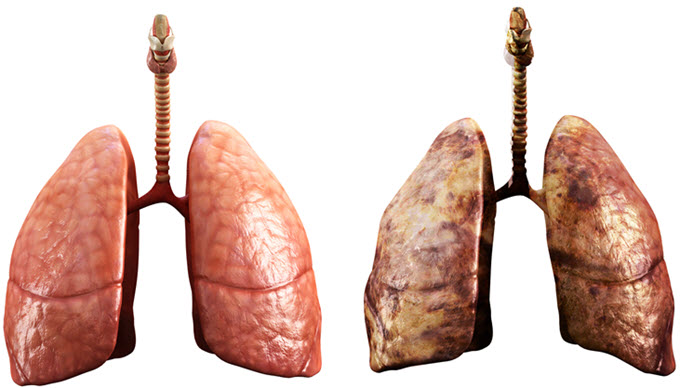
Some people are genetically predisposed to developing chronic obstructive pulmonary disease. This is due to a mutation that prevents a protein called alpha-1 antitrypsin (AAt) from exiting the liver. This protein is produced in the liver and used by the body to fix environmental damage in the lungs. With this mutation, AAt is produced in excess causing polymerization, or chains of the protein that are too big to exit the liver. People with this mutation are more likely to develop chronic obstructive pulmonary disease, emphysema, and/or cirrhosis of the liver. A person can live with the mutation and be completely healthy or have one cigarette and develop emphysema. Researchers who found the genetic mutations have said that the major risk factors for developing COPD are whether or not that person smokes.

Image result for smoking

This mutation seems to work differently on a case to case basis. Recently, a person close to me developed COPD and after reading this article I was concerned that it could be genetic. However, half way through the article it stated that smoking was still the biggest cause of COPD and the person close to me had been a smoker for over 40 years. The second article below states facts about COPD including the statistic that 3.2 million people died of COPD in 2015.


http://health.usnews.com/health-care/patient-advice/articles/2017-06-02/does-copd-have-a-genetic-component
https://www.sciencedaily.com/releases/2017/08/170816221606.htm