Showing posts with label soil. Show all posts

Wednesday, May 7, 2025

Scientists Engineer Bacteria to Make Soil And Crops 'Glow' Different Colors

Researchers at MIT have developed a groundbreaking method to monitor soil and crop health using genetically engineered bacteria that "glow" in different colors when they detect specific environmental triggers like nutrients or pollutants. These engineered microbes produce unique pigments—such as biliverdin and bacteriochlorophyll—when exposed to certain stimuli, and these signals can be captured from afar using hyperspectral cameras mounted on drones or buildings. Unlike traditional bacterial sensors that require microscopic analysis, this system enables rapid, large-scale environmental monitoring in under 30 seconds across hundreds or thousands of square meters.
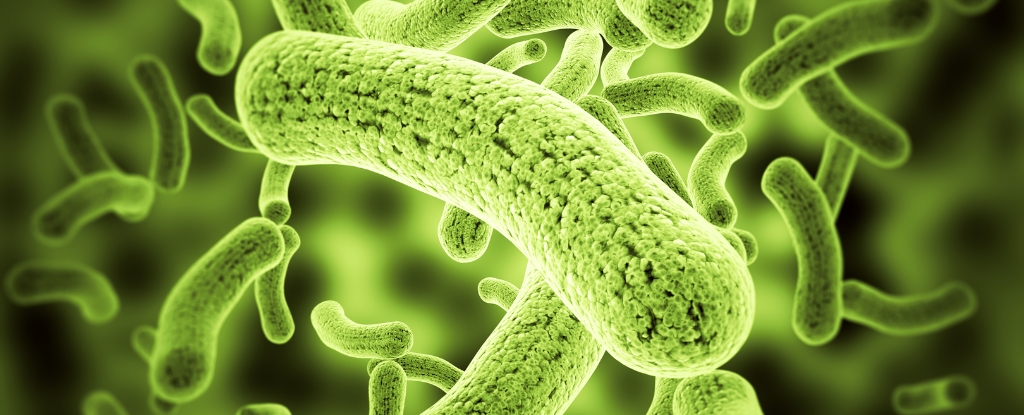
The engineered bacteria, including Pseudomonas putida and Rubrivivax gelatinosus, were designed to emit distinct light wavelengths when detecting specific targets, such as toxic metals or beneficial nutrients. The emitted signals, although invisible to the naked eye, are easily detectable by hyperspectral imaging, which identifies subtle spectral shifts. This “plug and play” system can be adapted to sense a wide variety of chemical or biological cues, making it a versatile tool for agriculture, pollution detection, and land management.

Funded by the U.S. and Israeli defense departments, the researchers emphasize the need to navigate regulatory and safety concerns. Still, they highlight the system’s potential as a sustainable, low-power, and persistent environmental monitoring technology.

Friday, April 25, 2025

StCDF1 and the Greener Way to Grow Potatoes

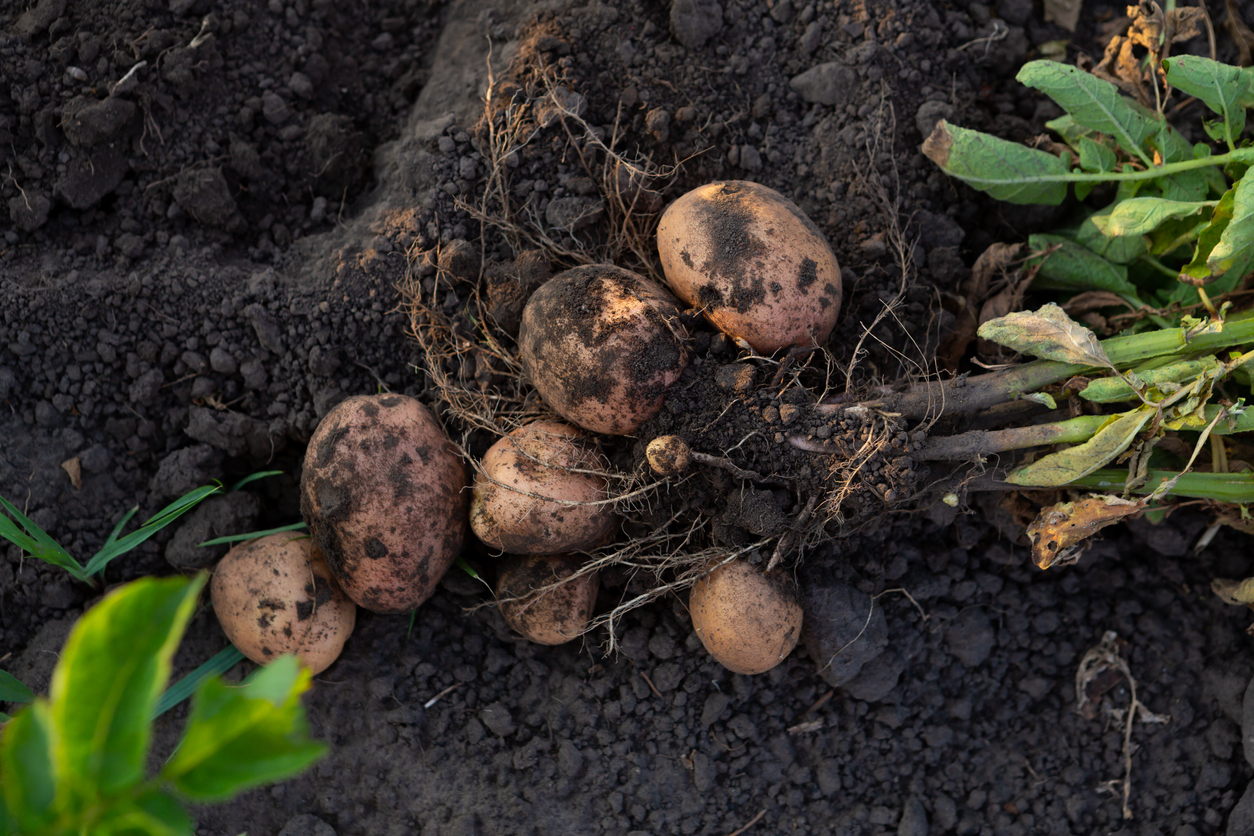
     Potatoes are one of the most popular starchy vegetables all over the world, but did you know to grow potatoes they use a lot of nitrogen fertilizer? Nitrogen fertilizer is harmful for the environment and is expensive for farmers to buy. Researchers recently discovered the StCDF1 gene in potatoes, this gene helps control when potatoes grow tubers. Tubers are the parts of the potato that we consume. The StCDF1 gene also affects how efficiently the plant is able to absorb nitrogen. What the StCDF1 gene does, is turns off the enzyme that helps the plant use nitrogen, knowing this now makes sense to why potatoes currently need so much fertilizer to grow. When colder places in Europe were growing potatoes, the StCDF1 gene became more active, which enabled the tubers to grow throughout the colder seasons but reduced nitrogen efficiency even more. Researchers were able to disable StCDF1 to test what would happen, it resulted in the plants growing lots of big leaves and roots with no tubers. This left them thinking that the older potato varieties probably used nitrogen more efficiently. In the future, scientists are going to try to modify the StCDF1 gene and crossbreed to create potatoes that will grow efficiently without using a ton of fertilizer. 


    This article really interested me because it demonstrates how one gene like StCDF1 can make a huge impact on how potatoes grow and how efficiently they use nitrogen. This study's finding can help farmers out a lot because they will be able to spend less on fertilizer while producing good quality potatoes. Not only will this help farmers out but it will also be helping our environment. Soil with excess nitrogen damages ecosystems, pollutes water, and adds to our global warming problem. This article puts into perspective how much genetics impacts real world situations. Applying genetics to industries like the agriculture industry makes it more interesting to learn about. 

Wednesday, April 24, 2019

Would you like a banana?

Or in this case soil? In most species the makeup of the gut is determined by genetics. However, a recent study shows that this is not true for baboons. Previously, studies have shown that the baboons' microbiota differs across populations. Researchers started to question whether this was caused by genes shared with relatives, the distance between populations or possibly the environment.  How did they conduct their analysis? Well they had the dirty job of collecting poop from 14 different baboon populations all across Kenya. Not only did they collect their poop they analyzed it along with looking at 13 different characteristics of the environment of where it was collected.


As it turns out, soil has the greatest impact on the makeup of the baboons' guts. It predicted the differences of the microbiota in different populations three times better than the distance in between the populations and a whopping 15 times better than genetics. This is fascinating because it brings a whole new meaning to "you are what you eat". I didn't realize how much soil baboons consume until realizing that a lot of the leaves, fruits, seeds and insects they eat are either covering in a dusting of soil or are straight off the ground.

Sunday, April 15, 2018

New Hope for Antibiotics from Backyard Soil

Researchers at Rockefeller University in New York have discovered new antibiotics  called malacidins from a bag of backyard dirt. Through innovative genetic sequencing techniques, researchers are able to sequence thousands of soil bacteria that they couldn't grow or study in the lab before. Biochemists at the Rockefeller Laboratory for Genetically Encoded Small Molecules said that they put the DNA extracted from the soil and put it into a bug that could easily be grown in the laboratory to see if it could develop new molecules.
Current Studies of the new antibiotic show that the new compounds interfere with infectious bacteria's  ability to build up cell walls. In lab tests, bacteria was exposed to the new antibiotic for 21 days and did not develop a resistance. It is also showing safe and positive results in mice, but there are currently no plans to do human testing yet as more testing needs to be done first.
The discovery of new types of antibiotics is very important as over time, bacteria become more and more resistant to antibiotics currently available, making it difficult to be able to kill these resistant strains as medicine runs out of stronger antibiotics.

Article: Scientists Unearth Hope for New Antibiotics
Original Study: Culture-independent discovery of the malacidins as calcium-dependent antibiotics with activity against multidrug-resistant Gram-positive pathogens

Monday, May 1, 2017

Our DNA is Everywhere


Researchers have found a new way to study early human species without looking for fossils. By searching in places early human species such as Neanderthals and Denisovans resided, soil samples can be taken from sediments in those places and their DNA can actually be found there. DNA can be found from many different organisms in almost any soil or water sample. Specifically for this study, researchers searched in sediments from cool caves and in permafrost. These two locations help the DNA stay in tact longer, so there is a good chance that in tact DNA will be found there. These researchers did in fact find DNA in the soil samples they collect and are positive the samples are from Neanderthals or Denisovans. The DNA they collected had the same characteristics as the known characteristics of DNA from Neanderthals and Denisovans. This new technique can helps us get a better understanding of how, when, and where our ancestors migrated.

https://www.newscientist.com/article/2129259-mud-dna-means-we-can-detect-ancient-humans-even-without-fossils/
http://science.sciencemag.org/content/early/2017/04/26/science.aam9695

Monday, April 10, 2017

The dirt in your backyard may hold the key to isolating cancerous tumors


University of Iowa researchers have found a gene in a soil-dwelling amoeba that functions similarly to the main tumor-fighting gene found in humans, called PTEN. When healthy, PTEN suppresses tumor growth in humans. But the gene is prone to mutate, allowing cancerous cells to multiply and form tumors. PTEN mutations are believed to be involved in 40 percent of breast cancer cases, up to 70 percent of prostate cancer cases, and nearly half of all leukemia cases, according to a review of the literature by the UI researchers. After some searching, the team found that an amoeba, Dictyostelium discoideum has the gene ptenA, which mutates similarly to the human PTEN gene and causes behavioral defects in the cell. The researchers hypothesized that ramping up the presence of lpten, making it the star on the court, could overcompensate for the mutated ptenA. If their hypothesis holds accountable, it can lead to new ways to treat cancer. Read more here 
more information