Showing posts with label neural networks. Show all posts

Thursday, December 1, 2022

Designing and Programming Living Computers


    Graduate students and researchers from Technion and MIT collaborated to produce cells designed to perform computations similar to artificial neural circuits as explained in this article. A plasmid was inserted into a cell, acting as an artificial neural network. This was made possible by altering the plasmid’s genes, giving the plasmid the ability to activate and deactivate those genes due to stimuli. This is similar to how computer code works. Computer code consists of 0/1 switches, and the combination of those switches allows for different functions to be performed. The presence or absence of a molecule in a cell can act as a switch and perform similar functions. A cell can then be “programmed” to perform a function or set of functions such as the OR or AND functions. Artificial intelligence algorithms were also used to reduce the time and cost of genetic modifications to bacterial cells, making this technology more accessible. This technology is in a very early stage but has shown great potential to improve the dosage and effectiveness of cancer immunotherapy and diabetes drugs amongst other things.

Monday, October 28, 2019

Neural activity and human longevity are linked together?


Recently, researchers found out that the nervous system’s activity could influence the lifespan of human beings when study with protein REST. Studies show that overactivity linked with longer life, while neural excitation results in a shorter lifespan. Research led by scientists in the Blavatnik Institute at Harvard Medical School based it finding on mice, worms, and human brains from. Protein REST is the key to signaling. This protein protects the aging brain from dementia and other specific stresses that affect the brain. When blocking REST, it led to higher neural activity and caused earlier deaths. When REST increases, it did the opposite.

Image result for neural activity in the brain


This seems like great information to know about because who knows, neural activity and human longevity are linked together? The article gave an example of that stress is an example of overactivity. Now that I thought about it, stress is happening more and more nowadays, and does that mean the life expectancy will lower and lower? I mean, like, I am stressing out right now too about my schoolwork, and will that mean my life expectancy will be lower due to overactivity of thinking??

https://www.sciencedaily.com/releases/2019/10/191016131224.htm

https://www.ibtimes.com/recent-study-discovers-link-between-human-longevity-neural-activity-2855030


Tuesday, September 27, 2016

Artificial Stimulation of the Brain

Researchers at the University of Pennsylvania and the University of Buffalo conducted an interesting study related to stimulation of brain regions.  Brain stimulation is used to treat patients that have certain disorders by using electricity.  Researchers were trying to determine which areas or regions of the brain to stimulate based on the disorder.  This was increasingly difficult because each region connects to other regions in ways that are not understood.  To learn more about brain stimulation, these connections and pathways had to be studied and evaluated.
Using a model mapped from an MRI scanner, eight individuals' brains were evaluated. Every region in the brain (there are 83) were stimulated. With the exception of a few outliers, the majority of the results were the same.  When stimulating certain regions of the brain, network hubs in particular, the activation of many regions within the brain was shown.  This may be linked to the amount of white matter within these areas.  The white matter connects regions of the brain together, and these regions resulted in a higher amount of activation when one region was stimulated.

Within the two sub-networks of the brain, the subcortical network and the default mode network, there were dramatic changes caused by the stimulation. The subcortical network stimulation resulted in many regions being triggered. The default mode network also had many regions switched on, but only where the white matter was linked to another region.

This research shows that treatment of disorders is possible in the future by doing a complete change in the brain network from stimulating the subcortical network or by performing a more specific change throughout the brain from stimulating the default mode network.  This is promising research within the neuroscience field. With more research in the future, electric stimulation could cure certain disorders.

Tuesday, March 1, 2016

Seeing the Light on Opto-Genetics

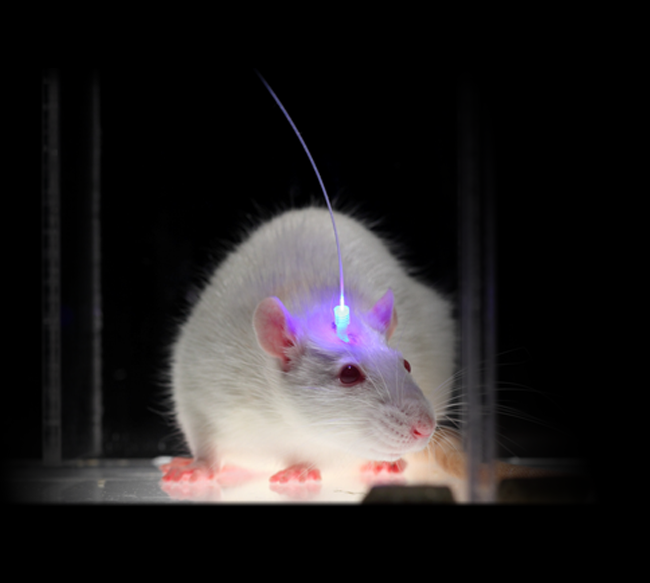
An article I previously posted entitled, See-Weed? , highlighted opto-genetics with the use of an algae extracted, light sensitive protein Channelrhodopsin-2 in a virus injecting the photosensitive characteristics into our brain. 


When you first think Opto-genetics, visual advances may be the first thought, because light is co-related with vision. But the science of the virus being able to add a new gene where cells will be reproduced to have the light activated characteristics integrated in a new area can infiltrate areas where light receptors do not normally reside. This is shown in mice video in my last article, how the virus allowed a control of movement. 

However as I was thinking about the neurological components of light, I wondered if it could be used to help fight depression. Currently there is a market for "light boxes" where patients with depression and bipolar receive therapy from a lighted source for 30 minutes a day. It has proven to be effective a scientifically grounded way to reduce depression. 

What if it went a step forward and those with depression were prescribed this virus? Dr. Deisseroth from Stanford University is heading opto-geneticstudies. He is able to "control individual signaling pathways in neurons on a timescale of tens of milliseconds. " This magnitude of control is unheard of in any other neuroscience field. His team is working towards studying this field, and studying the mechanics of depression in order to target it. A whole new market could be made of neural-prosthetic to control mood and psychology, 

As I continued to research this, a slippery slope was presented as some alluded to opto-genetics alluding to mind control. Is a slippery slope valid, would the benefits of a potentially ultimate method for saving lives of suicidal individuals be worthy? Should all of society have access to a uniform happiness and influx of serotonin? Are we already controlling our mind with the large amount of SSRI's being prescribed? Is it necessarily a bad thing?


Friday, April 13, 2012

Neural Networks could be how Intelligence Evolved

From Scientific American, is an article pertaining to the brain and the evolution of intelligence through working with others to complete a task. This was suggested based on a computer simulation that shows neural networks "learning" to work together. These results support a theory of social interactions being the root cause of brain development in human ancestors. Researcher Luke McNally said "it is the transition to a cooperative group that can lead to maximum selection for intelligence." This would explain why the technical cave man, who usually did things alone, became more civilized and learned that with others, more was accomplished.


The reason that the brain could have evolved from this acitivty is because neural networks send signals to one another, and reproduce random mutations and extra neurons, which was all simulated via computer. The researches used two difference scenarios to test the computers and how the brain would evolve. This scenarios were then tested with 50,000 generations of neural networks were experiment, and "intelligence" was measured by the number of nodes after each play. This article caught my attention because we never think of how we have evolved to our current standing. We know the physical differences, as well as the differences of our brain, but we do not fully understand how we have gotten here.