Showing posts with label methylation of DNA. Show all posts
Showing posts with label methylation of DNA. Show all posts
Monday, February 18, 2019
Cancer Clues
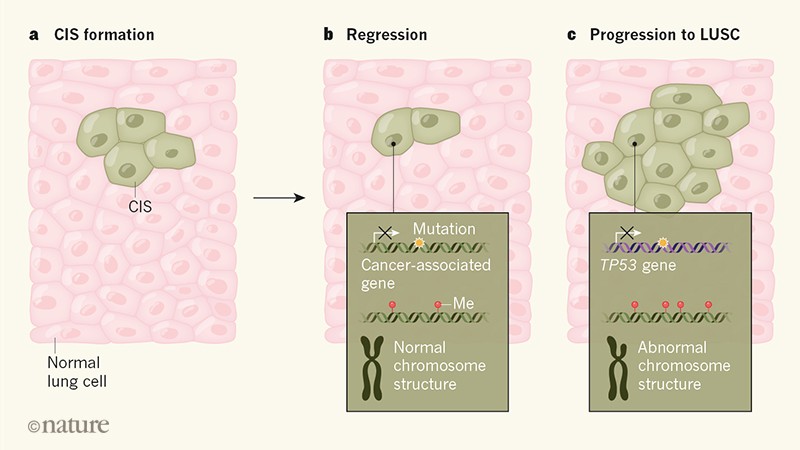
Genetic clue's can now be used to predict whether early-stage cancer will form an invasive tumor. One type of non-invasive tumors, Carcinoma In Situ or (CIS), that occurs within the lungs can either remain noninvasive or progress into an invasive form known as Lung Squamous Cell Carcinoma (LUSC). Until recently scientists were unable to predict which CIS growths would persist. But now a a set of genomic alterations from a lung tissue sample can readily anticipate which tumors will become invasive. 129 lung tissue biopsy's were studied through a range of genomic anaylses including whole-genome DNA sequencing, analysis of RNA expression, and profiling of a DNA modification called methylation that can influence gene expression. Within the whole-genome sequencing 29 samples progressed to LUSC while 10 regressed to CIS. Almost all of the progressive samples had mutations in the tumor suppressor gene, TP53. The progressive samples also acquired a distinct pattern of chromosomal amplifications and deletions of sequences that are commonly found in squamous cell carcinomas. The regressive CIS generally lacked these chromosomal aberrations. A statistical method of analysis was further used to demonstrate that DNA methylation patterns in the regressive CIS samples were more similar to those of normal lungs in comparison to the patterns within a progressive tumor. While scientists were able to target the differences in mutations between CIS and LUSC, the reason for progression is still unknown. We can pin point which CIS growths will persist, yet we do not know which changes are essential for the invasive cancer to form. The evolution of CIS to form invasive carcinomas have also been studied in Breast cancer and continue to make remarkable advanced in early detection. I find this discovery very exciting and possesses a ton of potential to help treat patients before the non-invasive tumors become invasive and life-threatening.

Wednesday, March 22, 2017
Predicting Death
Methyl labels are key to determining whether a gene is being deactivated or read. Observing methylation at specific placements in the genome, scientist found links with cancer and other diseases. Only in certain combinations of DNA called CpGs, can you find methyl groups. Scientists analyze 500,000 levels of methylation to determine if there was a link to survival. They found that there was a connection between methylation and mortality in 58 of the CpGs. Smoking has the biggest effect on methylation and increasing mortality rate. DNA methylation seems to be reversible, so if a person quits smoking their mortality rate will decrease at a high rate.

Overall, DNA methylation seemed to relate most to survival. I think it's kind of a cool concept. It almost seems like if scientists can figure out how to increase methylation or keep it from ever decreasing, maybe life expectancies will continue to grow.
https://www.sciencedaily.com/releases/2017/03/170320104008.htm
http://www.nature.com/articles/ncomms14617
Overall, DNA methylation seemed to relate most to survival. I think it's kind of a cool concept. It almost seems like if scientists can figure out how to increase methylation or keep it from ever decreasing, maybe life expectancies will continue to grow.
https://www.sciencedaily.com/releases/2017/03/170320104008.htm
http://www.nature.com/articles/ncomms14617
Monday, April 11, 2016
Mom’s Smoking Can Alter Fetus’s DNA
Despite the large amount of research and warnings, studies have shown that 12% of pregnant women in America still smoke. Studies are also showing that smoking during pregnancy can actually alter the DNA of the fetus and lead to birth defects such as low birth weight, asthma, and cleft lips/palates. In order to collect this data, researchers gave questionnaires to 7,000 mothers from around the world where they were asked how often they smoked during their pregnancy. Also, they collected a blood sample from each newborn’s umbilical cords so that they could examine their DNA. The studies showed that DNA does not change the DNA sequence in smoke-affected babies, but affected which genes were turned on or off. For example, “methylation” is when a small molecule is added onto DNA, preventing a certain section from being turned on, which can lead to birth defects. Even though the fetuses aren’t breathing in the smoke, many toxins from cigarettes will pass through the placenta and into the fetus. Researchers believe that methylation plays a large role in the effects on the DNA in the fetus.
It is alarming to me that a percentage of pregnant women in the country still smoke while pregnant. Even though 12% is not that high while looking at the big picture, in reality 1% would still be too high a number. Also, this percentage doesn’t take into account the amount of women who lied and said they did not smoke while pregnant. The effects of smoke on adults is significant and can lead to a number of health complications over time such as various types of cancers and heart disease, so I can only image how many complications these affected fetuses will have growing up. It is also often said that these fetuses are more likely to die from Sudden Infant Death Syndrome and if they do live, they have an increased chance of ADHD. Mothers are supposed to love and care for their children, and smoking while pregnant is selfish because their addiction can lead to lifelong complications or even death for their child.

Wednesday, November 19, 2014
Mother's Diet and Child's Gene Expression
It has already been shown that the diet of female animals upon conception can have obvious effects on their offspring. For example, studies have shown that a female mouse's diet can permanently effect the coat color of her offspring. It has always been suspected that their must be similar correlations between a mothers diet and the genes of her offspring in humans. Researchers with MRC International Nutrition Group have shown that a human mother's diet can have significant effects on the "silencing" of her child's genes.

There is a strong dependence on the consumption of grown foods in Gambia. There is also distinct rainy and dry seasons which have extreme effects on the growth of these foods, meaning the diets of Gambia's people changes with the seasons. Researchers sampled 167 pregnant women (84 of which conceived at peak of rainy season and 83 conceived at peak of dry season) and tested nutrient levels in their blood as well as examining the genes of the child. It was found that those mothers who conceived at the peak of the dry season consistently had children with less methyl groups (which are used for the silencing of certain genes) than those who had conceived at the peak of the rainy season. The inability of silencing certain genes can have serious repercussions such as proneness to disease. Good nutrients at the time of conception is vital for gene expression and to help avoid some diseases. This is a revolutionary breakthrough in that scientists can now continue testing and begin on helping mothers to be to create prime diets for optimal methyl group production.
Article Link: http://www.sciencedaily.com/releases/2014/04/140429125733.htm
Related Article: http://www.genengnews.com/gen-news-highlights/mother-s-diet-has-life-long-effects-on-child-s-gene-function/81249809/
There is a strong dependence on the consumption of grown foods in Gambia. There is also distinct rainy and dry seasons which have extreme effects on the growth of these foods, meaning the diets of Gambia's people changes with the seasons. Researchers sampled 167 pregnant women (84 of which conceived at peak of rainy season and 83 conceived at peak of dry season) and tested nutrient levels in their blood as well as examining the genes of the child. It was found that those mothers who conceived at the peak of the dry season consistently had children with less methyl groups (which are used for the silencing of certain genes) than those who had conceived at the peak of the rainy season. The inability of silencing certain genes can have serious repercussions such as proneness to disease. Good nutrients at the time of conception is vital for gene expression and to help avoid some diseases. This is a revolutionary breakthrough in that scientists can now continue testing and begin on helping mothers to be to create prime diets for optimal methyl group production.
Article Link: http://www.sciencedaily.com/releases/2014/04/140429125733.htm
Related Article: http://www.genengnews.com/gen-news-highlights/mother-s-diet-has-life-long-effects-on-child-s-gene-function/81249809/
Thursday, April 5, 2012
Exercise Can Change the Expression of your Genes
According to a study published in the journal Cell Metabolism, exercise not only helps you burn calories, but also alter the expression of your DNA. The researchers worked with a group of 14 young men and women who were relatively sedentary, and asked them to work out on an exercise bike that measured their maximum activity levels. In a painless biopsy procedure performed under anesthesia the researchers took a little bit of muscle from their quadriceps before and after a 20 minute exercise session.
they found that more genes were turned on in the cells taken after the exercise and showed less methylation, a molecular process in which the chemicals called methyl groups settle on the DNA and limit the cell’s ability to switch on certain genes. The body regulated the activation of genes in the DNA by regulating the methylation of cells at specific times.

In the muscle cells, the methylation process helps control the release of enzymes and nutrients the muscles needs to get the energy and to burn calories during physical activity. The researchers also tried to see if the intensity of exercise made a difference in the methylation process, and they found out that the muscle biopsies taken from participants with higher intensity workout had a lower concentration of methyl groups and therefore more RNA, than sample taken from participants that did a lower intensity workout.
"Exercise is already known to induce changes in muscle, including increased metabolism of sugar and fat", says Juleen Zierath, a professor of physiology at the Karolinska Institute in Stockholm, "Our discovery is that the methylation change comes first."
Subscribe to:
Comments (Atom)