Showing posts with label carcinoma cells. Show all posts
Showing posts with label carcinoma cells. Show all posts
Monday, February 18, 2019
Cancer Clues
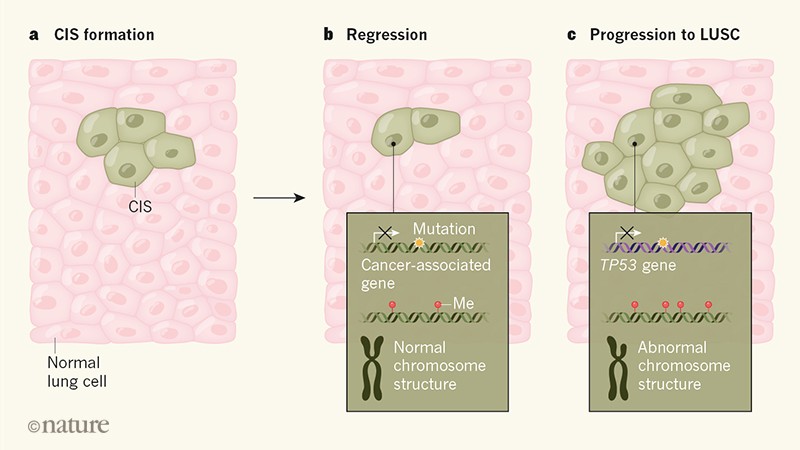
Genetic clue's can now be used to predict whether early-stage cancer will form an invasive tumor. One type of non-invasive tumors, Carcinoma In Situ or (CIS), that occurs within the lungs can either remain noninvasive or progress into an invasive form known as Lung Squamous Cell Carcinoma (LUSC). Until recently scientists were unable to predict which CIS growths would persist. But now a a set of genomic alterations from a lung tissue sample can readily anticipate which tumors will become invasive. 129 lung tissue biopsy's were studied through a range of genomic anaylses including whole-genome DNA sequencing, analysis of RNA expression, and profiling of a DNA modification called methylation that can influence gene expression. Within the whole-genome sequencing 29 samples progressed to LUSC while 10 regressed to CIS. Almost all of the progressive samples had mutations in the tumor suppressor gene, TP53. The progressive samples also acquired a distinct pattern of chromosomal amplifications and deletions of sequences that are commonly found in squamous cell carcinomas. The regressive CIS generally lacked these chromosomal aberrations. A statistical method of analysis was further used to demonstrate that DNA methylation patterns in the regressive CIS samples were more similar to those of normal lungs in comparison to the patterns within a progressive tumor. While scientists were able to target the differences in mutations between CIS and LUSC, the reason for progression is still unknown. We can pin point which CIS growths will persist, yet we do not know which changes are essential for the invasive cancer to form. The evolution of CIS to form invasive carcinomas have also been studied in Breast cancer and continue to make remarkable advanced in early detection. I find this discovery very exciting and possesses a ton of potential to help treat patients before the non-invasive tumors become invasive and life-threatening.

Saturday, November 24, 2018
Dual Action Cancer Killing Virus
Dual Action Cancer Killing Virus
A big risk with cancer cells in the body, is that when they develop, they are able to trick adjacent cells into shielding the cancer from the immune system. Scientists have now programmed virus' that kill carcinoma cells or cancer cells with a specific protein which can also target and then kill the adjacent cells which are tricked into protecting cancer cells from the immune system and then killing all cancer cells in the body. Its the first time we are able to now take the cells that are protecting the cancer and remove them. They have already been tested in mice and cancer samples from humans and could be tested on live humans as soon as next year. The previous problem with this idea is that the fibroblasts who are tricked are not the only ones who are killed, other fibroblasts in the body are also killed which leads to toxicity in the body.The new virus is called enadenotucirev and has so far only infected cancer cells and not healthy cells. The protein this carries is called T-cell engager and it binds to two types of cells and stick them together. The two here are the fibroblast and the other is T-cells. This then triggers the T-cells to kill the fibroblasts. When this was tested, it was tested on prostate cancer tumor samples which reflect the same makeup along with it being tested on healthy bone marrow to make sure it did not cause toxicity which it did not. Dr Michelle Lockley, an expert from the renown cancer research UK said "Using the power of the body's own immune system to tackle cancer is a growing area of research...one of the biggest challenges of immunotherapies is predicting how well they will work with the patients immune system, and understanding what the side effects could be." This type of virus could typically target specific cancers such as skin, tissues that line or cover internal organs, or pancreas, lungs, colon, breasts, ovaries, and prostate cancer.

Link; https://www.sciencedaily.com/releases/2018/11/181119064142.htm
Subscribe to:
Comments (Atom)