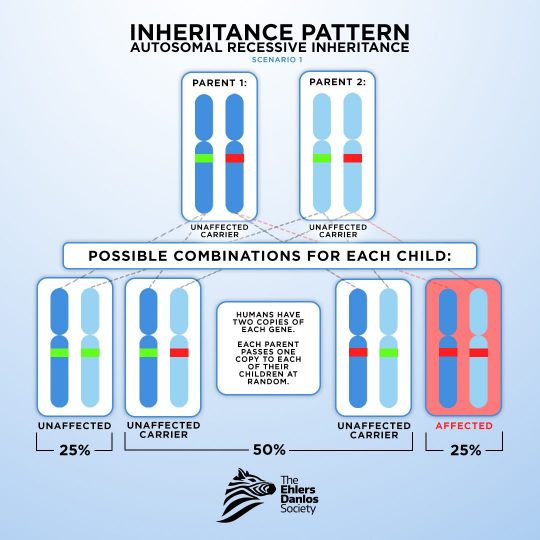
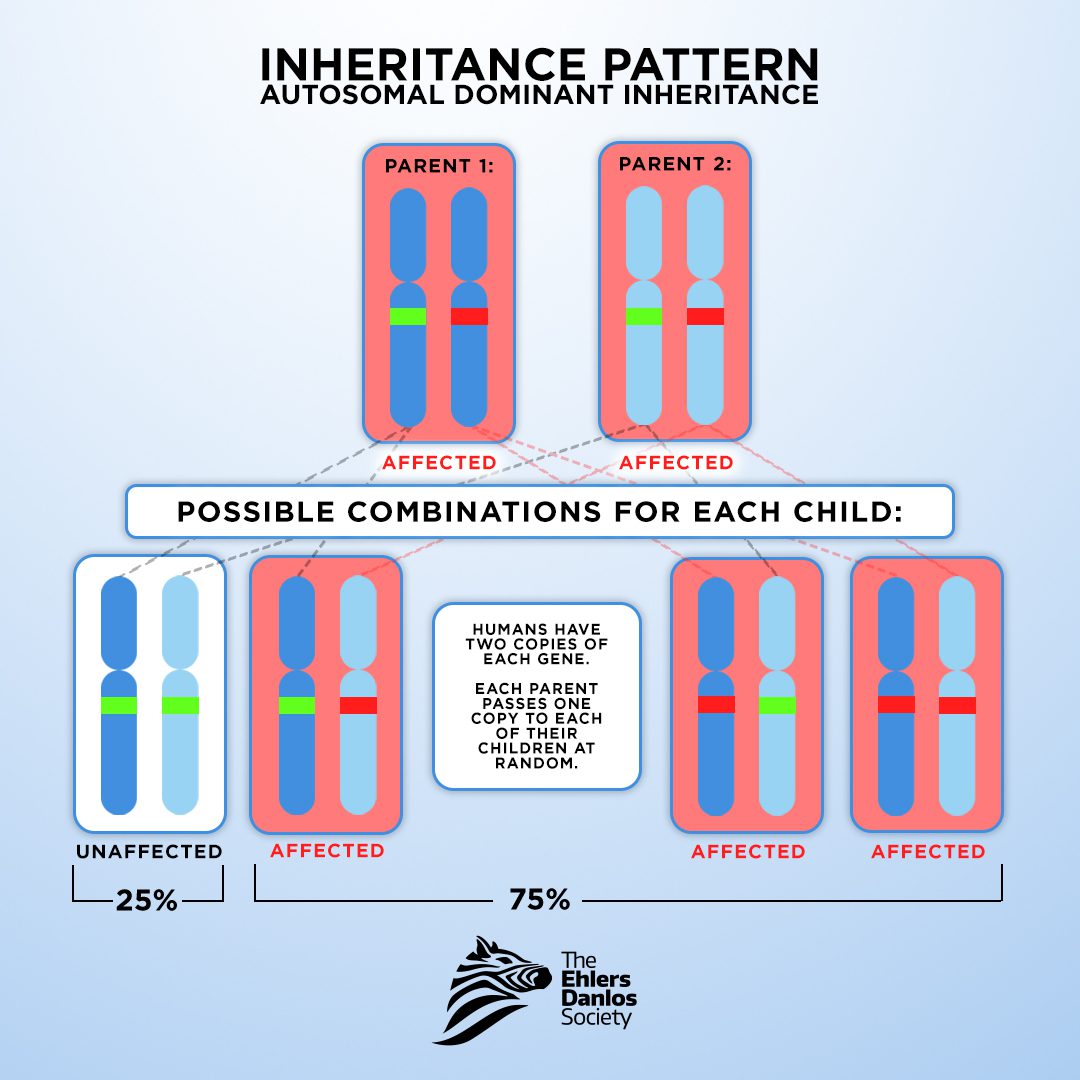
Ehlers-Danlos syndrome is an inherited condition that affects the connective tissues mostly skin, joints, and blood vessels. The most common form of EDS is hypermobility Ehlers-Danlos syndrome They're all associated with a variety of genetic causes passed on and inherited from parent to child. Depending on the type of EDS it could have come from one or both parents. There are more than 20 genes found to be the cause of EDS. Some of the genes associated with Ehlers-Danlos syndrome, including COL1A1, COL1A2, COL3A1, COL5A1, and COL5A2, provide instructions for making pieces of several types of collagen. When the genes are disrupted the process of creating collagen is affected creating changes in the weakened bones connective tissue stretching which are the characteristic traits of EDS. Inheritance of EDS depends on the type of syndrome type you have. Some have autosomal dominant or autosomal recessive. In recessive two copies of the genes in the cells are altered and one parent is the carrier but does not show signs or symptoms of the disorder. There is a chance that one in four children can get the condition from both parents. In autosomal dominant one copy of the altered gene in each cell cause the disorder and is inherited from one affected parent. While there is also a chance that a kid can get the disorder without any family history of it this is called new de novo gene variants.
https://www.nhs.uk/conditions/ehlers-danlos-syndromes/
https://medlineplus.gov/genetics/condition/ehlers-danlos-syndrome/#inheritance
https://www.ehlers-danlos.com/genetics-and-inheritance/

