Showing posts with label blue eyes. Show all posts

Wednesday, April 3, 2019

Eye Color; Myths of Genetics

There are many myths regarding genetics and inheritable traits. Even when most of them have been clarified, people are still confused about some patterns of heredity. One of the most popular myths of genetics is eye color, specially those in the blue category since it is less common.
People used to believe that eye color were single genes, and that blue is a recessive allele of other non-blue eye colors like greens and browns. A research on myths of human genetics by John McDonald notes that eye color is not a simple hereditary trait, in fact there is at least 12 genes involved and phenotypes vary not only with the genes themselves but also with the interactions with each other.

Heterochromia: Different pigmentation/concentration of melanin.
Many articles explain that the coloration of the eyes is mainly based on the presence and absence of melanin, and that essentially there is only one eye color, brown; other colors are a product of reflection and absorption of light. Melanin is a brown pigment that absorbs light; in blue eyes, there is less melanin thus more light is reflected. For eye color, there are genes that determine the melanin's quality, quantity, dispersion, concentration, etc. Other factors like the amount of collagen in the iris and blood vessels can also affect the color expressed. Eye color is still believed to be genetic but is more complicated than simple dominant-recessive alleles.

Wednesday, April 26, 2017

Blue eyed humans have a single common ancestor


New research shows that people with blue eyes have a single, common ancestor. A group of scientists at the University of Copenhagen have found a genetic mutation which took place 6-10,000 years ago and is the cause of the eye color of all blue-eyed humans alive on the planet today. They originally said that all humans had brown eyes, but a genetic mutation affecting the OCA2 gene in our chromosomes resulted in the creation of a "switch," which literally turned off the ability to produce brown eyes. The OCA2 gene codes for the P protein, which is involved in the production of melanin. This switch  limits its action to reducing the production of melanin in the iris which is effectively "diluting" brown eyes to blue.  The mutation of brown eyes to blue represents neither a positive nor a negative mutation. It simply shows that nature is constantly shuffling the human genome, creating a genetic cocktail of human chromosomes and trying out different changes as it does so. 
Original article here
Who is correct? An article arguing with the original article

Friday, April 8, 2016

Could all Blue-eyed Humans have a Common Ancestor?


Recent studies have found that people with blue eyes all have a common ancestor.  A research team at the University of Copenhagen has discovered a genetic mutation that could have taken place between 6-10,000 years ago! This genetic mutation is what causes the blue eye color in humans today.  The mutation affects the OCA2 gene, which created a switch that can turn off the ability to produce brown eyes.  This gene codes for the P-protein, which helps produce melanin.  Melanin in our body defines the color of our eyes, hair, and skin.  The switch that is created from the mutation, does not turn the OCA2 gene off completely, but it reduces the amount of melanin that is produced, which basically dilutes the brown eye color to blue.  This switch could cause different mutations if the gene was turned off completely.  If the gene is turned off completely, this could lead to albinism. A person with albinism will not produce any melanin.

The amount of melanin in a person's iris will decide what color their eyes will be.  The color could range from brown to green, depending on how much melanin is in their eye.  Blue-eyed humans have a small degree of variation in the amount of melanin that is in their iris, while on the other hand, brown eyed humans have a large amount of variation from person to person.  The fact that blue-eyed humans do not have much genetic variation from person to person could prove that they all have a common ancestor.  In the research that was done, it was discovered that blue eyed humans have the same switch which is also located in the same spot on their DNA.  The blue-eyed mutation is neither negative or positive, humans acquire many mutations that do not affect their ability to survive.

This research was extremely interesting to me.  As a person with blue eyes, it is cool to see that I have a genetic mutation that changes the color of my eyes.  It surprised me that the same mutation that I have could also cause albinism.  It makes you think if the amount of melanin a person has in their eyes or even skin has something to do with how you react to sunlight.  It is said that people that have lighter eyes are more sensitive to the sun, and a lighter skin color could also be sensitive to the sun.  Does more melanin make you less sensitive to the sun?

Tuesday, December 15, 2015

The big blue mutation

“New research shows that people with blue eyes have a single, common ancestor. A team at the University of Copenhagen have tracked down a genetic mutation which took place 6-10,000 years ago and is the cause of the eye color of all blue-eyed humans alive on the planet today.”

Researchers have found that originally we all had brown eyes. It was a genetic mutation affecting the OCA2 gene in our chromosomes that resulted in the creation of a “switch” that turned off the ability to produce brown eyes. The OCA2 gene codes for a protein which is involved in melanin production, the pigment that gives color to hair, eyes, and skin. The “switch” is located adjacent to the OCA2 gene and it limits the production of melanin. By this happening, brown eyes are essentially diluted to blue. It is believed that everyone with blue eyes has a common ancestor and that is how they all inherited the same switch at exactly the same spot in their DNA. 

Article Used: http://www.sciencedaily.com/releases/2008/01/080130170343.htm
Related Article: http://www.livescience.com/9578-common-ancestor-blue-eyes.html

Wednesday, November 26, 2014

Blue-Eyed People May Face Higher Melanoma Risk


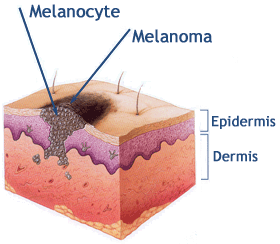
      Melanoma is a form of skin cancer that when exposed to the sun for too long, can become a very deadly form of cancer. Those with blue eyes or red hair are unfortunately more prone to getting moles which is the precursor for melanoma. Neil Box an assistant professor at the University of Colorado, in Denver, said "if you modify the behaviors related to sun exposure in children, it will probably make a difference for their well-being in later life with respect to melanoma." During the years of 2004-2008 researchers followed 477 white children between the ages of 6-10 around, and gathered DNA samples and provided information on their sun exposure. They found that with an increase in sun exposure the number of freckles and moles increased each year as well. Children in this study with blue eyes had a tendency to develop more moles than the average child, whereas children with red hair had a tendency to develop larger moles than the average child. Since children with pre-developed moles have a higher risk of getting melanoma it is imperative that those with blue eyes, and those with red hair protect their skin throughout their whole life. In my opinion, melanoma is not something you want to be diagnosed with. I think it is important that everyone protects their skin, especially those with lighter skin, blue eyes, and red hair. 


Original Link: http://health.usnews.com/health-news/articles/2014/11/19/blue-eyed-people-may-face-higher-melanoma-risk
Related Link: http://www.cancer.gov/cancertopics/types/melanoma