Showing posts with label IL-13. Show all posts

Friday, November 17, 2023

Eosinophilic Asthma how Interleukin 4 and 13 inhibitors are used to treat it


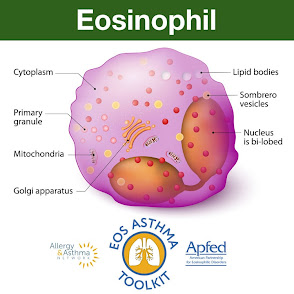
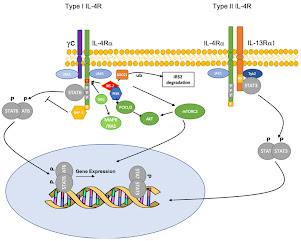
Eosinophilic asthma is a subtype of asthma that is often severe and characterized by the number of eosinophils found in the blood, lung tissue, and sputum in the respiratory tract. Asthma is defined as chronic lung disease the airways are inflamed with inflammatory cells and thickened walls and are obstructed with fluid and mucous. It causes spasms in bronchial tubs causing difficulty breathing. People with Eosinophilic asthma are known to suffer more from sinus infections and nasal polyps. There is a new type of medication that the FDA and researchers have been using to battle this type of asthma which is Dupixent (dupilumab) it is a dual inhibitor of the IL-4 and IL-13 signaling local and systemic type 2 inflammation in asthma where it binds to the IL-4 alpha receptor. Interleukin 4 and IL 13 are critical in allergic inflammation which is what eosinophilic asthma is. They both contribute to systemic and local (bronchial tube) inflammation. B-cell class switching and immunoglobulin E production. Geneticists have not been able to find a link between what causes eosinophilic asthma but there are other genetic links to regular asthma which associated with ADAM33, VDR, DPP10, PHF11, HLA-G, and GPR154. The genes are associated with elevated IgE, atopy, and bronchial hyperresponsiveness.


https://onlinelibrary.wiley.com/doi/full/10.1111/all.14151

https://www.dupixenthcp.com/asthma/about/mechanism-of-action#:~:text=DUPIXENT%20binds%20to%20IL%2D4%CE%B1,transient%20increase%20in%20blood%20eosinophils.

https://www.ncbi.nlm.nih.gov/pmc/articles/PMC7061408/#:~:text=The%20FDA%20approved%20asthma%20indications,Phase%203%20studies%20of%20uncontrolled

https://eosasthma.org/about-eos-asthma/

https://apfed.org/about-ead/eosinophilic-asthma/

Thursday, November 6, 2014

Asthma Causes Genetic Damage in Circulating Blood

     Until now, doctors have thought that the genetic damage caused by asthma was limited to the lungs. However, recent research at University of California, Los Angeles has shown that it negative affects the genes of peripheral, or circulating, blood in the body. 
     The study was conducted in an animal model that mimicked human asthma. Robert Schiestl, the senior author of the research, was the first to asses the role of IL-13 in genetic damage to cells. IL-13 is interleukin 13, a type of cytokine known to mediate inflammation. The research focused primarily on the over-expression of this IL-13. The results from Schiestl's studies have shown that IL-13 increases important elements of the inflammatory response, such as reactive oxygen species molecules. The research team found that reactive oxygen species-derived oxidative stress induced genetic damage with four main types of systemic effects in the peripheral blood. They are oxidative DNA damage, single and double DNA strand breaks, micronucleus formation, and protein damage. All of these effects cause the chromosome to become unstable, which can result in a variety of other diseases. 
     Schiestl and his team hope to use chemicals to repair the DNA of damaged cells. Their goal in doing this is to determine whether doing so will make asthma less damaging by reducing genetic instability in circulating blood. 

Robert Schiestl is a professor of pathology and radiation oncology at the David Geffen School of Medicine at UCLA.

     I found this article interesting because it is scary to learn that asthma affects the whole body more drastically than people think. Many people experience asthma and do not have it properly treated. It effects more than 150 million people throughout the world. This research shows how serious the disease can be.