Genetic Adaptations To Diving Discovered In Humans For The First Time
Recent studies showed that an indigenous people group in Indonesia, the Bajau, have genetically enlarged spleens. This may be due to acute hypoxia, low arterial oxygen supply where blood oxygen level insufficient. When diving the Bajau's heart rate slows and blood vessels in extremities shrink in order to prioritize blood flow to organs. The spleen is able to contract in order to increase the amount of oxygenated RBCs available. This process increases oxygen in the body's circulation by 9% allowing for up to 70m dives. The Bajau are able to dive without any equipment save for goggles for reportedly up to 13 mins straight.
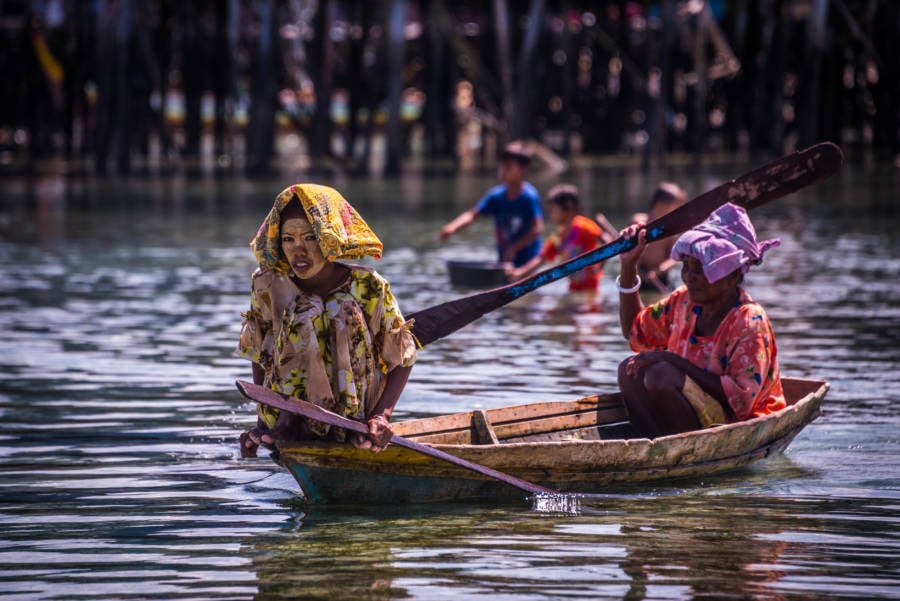
Free diving is the sport of diving underwater without the use of any breathing apparatus. This technique has been used for thousands of years by island communities to hunt and gather food. The Bajau people of Southeast Asia, known as "Sea Nomads," have collected food by free diving with spears. They now live around the islands of Indonesia and are renowned for their ability to hold their breath for incredible amounts of time. The members of this community can dive up to seventy meters with only some weights and a pair of wooden goggles. Since the Bajau people do not dive competitively, it is impossible to know exactly how long they can hold their breath on average. However, a diver in the Bajau community told a reporterthat he had once dived for over 13 minutes.
Other diving mammals, such as the seal, have disproportionately large spleens for their body. This led Melissa Llardo, from the Center for Geogenetics at the University of Copenhagen, to wonder if the same trend would follow in diving humans. She traveled to Indonesia and met the Bajau people, who were surprised that she had even heard of them. She then asked to take ultrasound pictures of their spleens and spit samples to compare to a related group of people from the Indonesian main land, the Saluan.
On average, it was found that the spleen size of the Bajau was 50% larger than that of the Saluan. From the spit samples the researchers also found a gene called PDE10A, which is thought to control a certain thyroid hormone. This hormone has been linked to spleen size in mice, and when they have a lower level of this hormone, they also have a smaller spleen size. The PDE10A gene was only found in the Bajau people, which could be an explanation for why they have larger spleens.
Melissa Llardo theorized that natural selection would have helped the Bajau people gain a genetic advantage over thousands of years of free diving. Unfortunetly, the Bajau way of life that has persisted for generations is increasing under threat. Overfishing is making it harder for the Bajau to subsist on their local stocks and because they live out to sea, they do not enjoy the same citizenship as those on the mainland. Because of this, many of the Bajau people choose to leave their "sea nomad" life, making their tribe smaller and smaller.
It has been found that the Bajau people, who reside in scattered communities in Indonesia, Malaysia, and the Philippines, may have evolved traits that make them better divers. The Bajau people dive for their livelihood, and have been doing so for centuries. Many have noticed that the Bajau people are more gifted than others in diving, as the Bajau people were observed to be able to dive more than 200 feet with their only equipment being wooden goggles. Dr. Melissa Ilardo, a geneticist, set out to study the people to see if they had, indeed, evolved traits that could aid them in diving. She visited the villages of the Bajau people and measured the size of their spleens, which have been found to play a key role in how deep an organism is able to dive. The larger the spleen, the deeper an organism is able to dive. Dr. Ilardo measured the spleens of nearby farmers that were not Bajau, and she compared the sizes to the Bajau people. She found that the spleens of the Bajau people were 50% larger than the spleens of the neighboring farmers. After conducting a DNA test, it was also found that the Bajau people shared a number of variant genes, which further suggested that natural selection had taken place within the population. A variant of a gene, PDE10A, was found within the DNA of the Bajau people; this variant influences the size of spleens. The more copies one has of the PDE10A variant, the larger that person’s spleen will be. The studies performed are not conclusive, however, and more research needs to be performed on the matter.
I found this article to be really interesting. The evolution between groups of people intrigues me, as it sounds amazing that a certain group of people can evolve to have a set of traits from other humans that help them survive better under certain conditions. It seems that, compared to humans like me, who live in a more neutral environment, it is as if the Bajau people have a biological advantage. The fact that the Bajau people are able to dive to depths of over 200ft, and at that rate, are able to hold their breath for long enough to dive that far down, shows how far the limits are that the human body can be pushed to. I also found it very heartwarming that the researcher who was performing the studies had such love for her research, and was so passionate as to travel all the way to the islands that the Bajau people live on in order to perform tests. Reading about how interesting the evolution of the Bajau people was, and how much Dr. Ilado loved her job, it made me imagine how fun it must be to be a geneticist researching the biological evolution of groups of humans.
A new study has found that the incredible long term diving found in the coastline communities of southeast Asia could have a genetic component that enables people to perform this feat. One such adaptation is a mutation for a larger than average spleen, which extends how long a person can wait underwater without needing air.
The study originated from the University of Utah, and included sequencing the genome of people born in two small towns in the area (one being a diving town and the other a farming community) and measuring their spleen. About 76 people participated in the study overall. During the sequencing unique mutations were found in the diving community, some having to do with the ability to stay underwater. I think its fascinating that there are people out there that have adaptations towards being able to swim for long periods of time deep underwater.
Link Article- https://www.scientificamerican.com/article/human-sea-nomads-may-have-evolved-to-be-the-worlds-elite-divers/
Link 2-http://www.peoplesoftheworld.org/text?people=Bajau
Recently, a team of researchers have gained particular interest in a group of individuals scattered across Indonesia, Malaysia and the Philippines. The Bajau, are a group of individuals who have been known for their abilities to dive 200 feet with just a pair of wooden goggles. This phenomenon is an ideal example of natural selection affecting humans in a more recent event. The Bajau people have suspected to start diving for sea cucumbers starting in the 1600s or possibly after the most recent Ice Age. When Dr. Melissa Ilardo, a genetics student at the University of Copenhagen, heard about these people she decided to take scans of the spleens of these individuals. Spleens allow the supply of oxygen-rich red blood cells into circulation during the so-called diving reflex. Turns out that those individuals who have bigger spleens have a mutant copy of PDE10A gene that influences the size of the spleen. This is new information to scientists as there has been no direct knowledge on what the PDE10A gene does. It has been shown that this gene controls the level of thyroid hormones inside the body but with this new data a new function may soon be determined. The Bajau people are a unique example of more recent natural selection in humans similar to the people in Tibet and their abilities to live at higher altitudes.

 Melissa Llardo theorized that natural selection would have helped the Bajau people gain a genetic advantage over thousands of years of free diving. Unfortunetly, the Bajau way of life that has persisted for generations is increasing under threat. Overfishing is making it harder for the Bajau to subsist on their local stocks and because they live out to sea, they do not enjoy the same citizenship as those on the mainland. Because of this, many of the Bajau people choose to leave their "sea nomad" life, making their tribe smaller and smaller.