Showing posts with label #survival. Show all posts

Sunday, April 6, 2025

Human and Neanderthal Mating Could Have Increased Our Success

 On December 12, 2024, BBC published an article about how Neanderthal DNA has seemed to help humans to thrive as a species. The article highlights how Neanderthal genes helped protect humans from diseases that had not been experienced yet. The DNA extracted from the fossil record helps to understand how individuals and populations relate to each other, but they also help to show migratory patterns. The populations that had migrated out of Africa to Europe had not survived until later populations began breeding with Neanderthals. While these populations ended up dying off about 40,000 years ago, their offspring did spread out and populate the world more and even eventually returned to Europe. The research also explains how previous hypotheses about why Neanderthals went extinct are likely incorrect and that it is supported that environmental factors would have been the most likely cause. The parts of Neanderthal DNA that humans held on to has likely been the reason for our success as a species. 

I find it interesting that a species that was less successful than humans is now believed to be critical in our success. It changes my perspective on past species and even humans as a species knowing that we would not be where we are today without these other species. The immune systems that developed from Neanderthal genetics helped the human species survive diseases they would not have normally. 

Tuesday, March 5, 2024

A Protein for Longevity Does Not Necessarily Guarantee Health

Longevity-promoting genes usually help organisms deal with stress- but a gene that lengthens nematode worm’s lives and is necessary for reproduction also makes the worm more susceptible to infection and stress. 

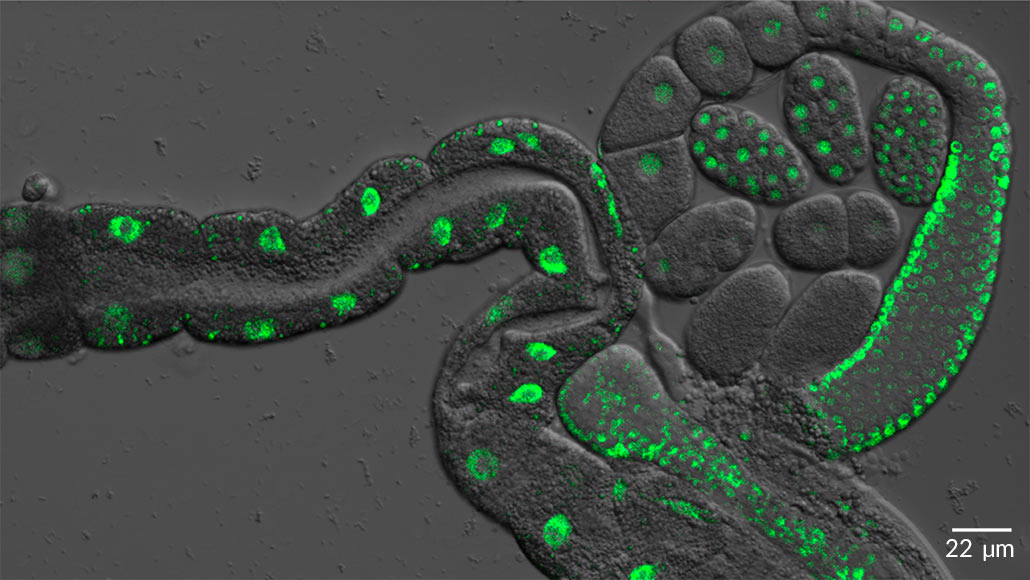
Arjumand Ghazi, a geneticist who studies aging at the University of Pittsburgh, published her laboratories work regarding the TCER-1 protein in the Nature Communications in 2017. Ghazi and her colleagues had previously found that a gene called TCER-1 increases life span and is needed for Caenorhabditis elegans worms to produce eggs and healthy offspring. Ghazi and her colleagues expected that removing the gene would leave the worms prone to infections- but after deleting the gene the worms fought off bacterial infection for nearly twice as long as worms with an intact gene. This was so unusual and unexpected for the Ghazi laboratory, Francis Amrit, a molecular biologist in Ghahzi's lab said “when I first saw that, I thought I’d made a mistake.”  


protein microscopy


Additionally, Ghazi’s team found that worms with more of the TCER-1 protein than usual were able to overcome declines in fertility caused by exposure to a pathogen, but succumbed to infection faster. Which meant the results were indicating that the normally functioning gene helps suppress immune responses so more resources can be used for reproduction. Worms missing the TCEr-1 protein were also resistant to other types of environmental stress such as heat and radiation. These advantages however only continued as long as worms were of egg-laying age, as older Caenorhabditis elegans worms were equally susceptible to infection or stress regardless if they had the gene. 


Organisms balance survival and reproduction all the time, which can be seen when an animal under stress tends to stop reproducing until conditions improve. The TCER-1 protein works with other proteins to achieve the same type of survival-reproduction balance. The details of how the TCER-1 protein senses stress and regulated fertility, longevity and stress response are still unknown however. 


While humans have a version of this gene, related research is unlikely to affect human health anytime soon- however such findings could be warning bells for researchers developing anti aging therapies. As there seems to always be some sort of desire to get closer and closer to immortality, I find it interesting to see how genetic studies on aging evolve during my lifetime. Overall, this article was a good and interesting read- it is truly thought-provoking to wonder how this field of genetics will grow.


Sources:

https://www.nature.com/articles/s41467-019-10759-z

https://www.sciencenews.org/article/gene-may-help-worms-live-longer-not-healthier


Thursday, November 15, 2018

X vs. Y Chromosome

A new study suggests that men are actually right when they say that women are “too complex”.  With the latest study of X and Y chromosomes, scientists have learned that the Y chromosome have much less complexity than having a double X chromosome. In fact, women are able to express genes 15% better than males due to having a double X chromosome.  
However, it has also been seen that the X chromosome is actually shrinking over the course of millions of years.  The Y chromosome performs such little gene expression that is basically unused, staying small similar to a pinky finger remaining small.  It could be hypothesized that the Y chromosome could actually shrink to such a minute size that it will disappear altogether.  But, as another study points out, the amount of genes and the Y chromosome remains the same because the genes, which only hold 100 of the original genes that the chromosome began with, are key to the males’ survival.
Scientists argue that the Y chromosome doesn’t only result in maleness and being fertile, but also having gene expression that differs from women, allowing different responses to diseases.  This means that males could be more prone to symptoms or risks from diseases than females, or vice versa.  By understanding these differences and as our medical technology advances, I believe that medication and certain techniques could be developed in order to cure specific diseases for either males or females in particular.  This may even aid in curing X-linked inheritable diseases.

Links:

Sunday, March 18, 2018

Ant raids: It's all in the genes


Scientist has recently been studying certain ant attacks and have been intergrading their offspring into their own colonies in order for survival. They have recently discovered that these raids required to achieve the goals are controlled by a different gene in each of the closely related ant (Temnothroax). This proves that through the different changed in the genetic material is due to random. This means that although there are several different paths, they could all have the same outcome.

Within this research, the scientist at Johannes-Gutenberg University Mainz was able to identify two specific attack genes in slave maker ants. The first gene is “Acyl-CoA Delta (11) Desaturase which causes the attackers to release chemical scents during the raid. These scent mask the attackers, which helps them lead a successful raid. On the other hand the other gene that was identified was called Trypsin-7, which appears to have an affect on the recognition potential of identifying the host colonies required for a raid.