Showing posts with label supertaster. Show all posts

Thursday, November 6, 2025

Is there a link between craving licorice and a specific gene?

Drain C. 

Genetics, Stockton University

https://link.springer.com/article/10.1186/2044-7248-1-22

Although not fully confirmed, there is a suspected link between cilantro tasting like soap and genetics. It is not necessarily linked to the taste of the cilantro itself but more so the way it smells. There are people out there who can not overcome the earthy smell of the cilantro, thus tasting like soap when eaten. This specific article is pointing out geographical location and the olfactory gene within people. More people from European countries can taste the earthy/soapy flavor whereas people from Central America/Latin countries taste the flavor less. Not only do the people taste it differently but the gene itself is more present in certain regions. Countries that have high coriander growth rates have a decreased OR6A2 gene, and countries that have a low cilantro growth rate have an increase in the soap taste gene. It was also revealed that people can overcome the smell and taste of the given herb with repetitions in trying it, does not eliminate the gene itself, but people can train themselves to like it. Dried cilantro has a completely different impact on people, probably because of the reduced scent of the herb it does not hit the neurons the same way as it would if it were fresh.


https://theconversation.com/the-science-of-liquorice-whether-you-love-the-dark-root-or-hate-it-74135

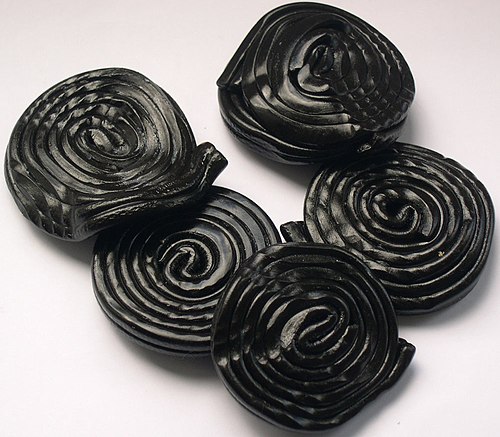
This specific thought process may be a reach but I wanted to try it out anyway. There was an already (semi) proven and thoroughly tested  study that has linked a specific gene OR6A2 to the taste and smell of cilantro/coriander, and why it tastes like soap, and there were studies that have linked the cravings of specific foods to various genes but there has never really been a specific study on licorice itself. Licorice has a very unique taste that some people love and some people hate, it is kind of hard to describe: kind of sweet, kind of medicinal, kind of salty. From a biochemical/neurological standpoint it is justifiable why people crave it, your body needs certain vitamins and minerals thus triggering a craving in the brain. But from a genetic viewpoint there is no link of the gene itself and the craving of licorice. That could be for many different reasons, whether there has not been enough scientific studies on it or there really is no actual gene for it. As a kid, I hated the stuff but I recently had a sudden need for it, i was just curious if it was similar to cilantro in it having a designated soap gene: or if my tastebuds have changed as I grew into adulthood. Either way- licorice is my new passion in life and I am excited to see what future geneticists have to say about it. 


https://archive.is/20240101045022/https://www.scientificamerican.com/article/your-genes-may-influence-what-you-like-to-eat/

https://pmc.ncbi.nlm.nih.gov/articles/PMC6930899/pdf/fgene-10-01272.pdf

Tuesday, October 8, 2024

Genetics vs Cilantro Aversions

     The short article published by Nature.com discusses how genetics plays a part in some people's aversion to coriander, also known as cilantro. To most individuals, cilantro is a delicious herb put on food to give it an extra layer of flavor. However, some loathe it, claiming it tastes like soap, stink bugs, dirt, and the list continues. This hatred is traced to genes that encode both olfactory and taste receptors. Approximately 21% of East Asians, 17% of European Americans, and 14% of people of African descent dislike the taste of cilantro, whereas 3-7% of South Asians, Latin Americans, and Middle Easterners dislike cilantro flavor, showing ethnic, exposure and environmental effects play a role in this phenomena. However, Charles Wysocki, a behavioral neuroscientist at the Medical Chemical Senses Center in Philadelphia, claims that coriander, cilantro, preference is influenced by genetics, after conducting a study in the early 2000s. He found that 80% of monozygotic twins (identical) shared identical preferences for cilantro, but fraternal or dizygotic twins concurred roughly half the time for the herb. Indicating that there is strong evidence that supports the existence of a genetic and heritable influence on whether one likes or dislikes cilantro. 

    Through another study through 23andMe,  Nikolas Eriksson successfully identified two genetic variances, when compared to the common public, that linked the distasteful flavors and sensations that came from an individual when they consumed cilantro. One of the strongest correlate variants is located in the olfactory receptor genes, one being the OR6A2. A gene that encodes for a receptor that is hypersensitive to aldehyde chemicals-- in this case, coriander, or cilantro, an herb that contains high levels of aldehydes. Lilli Mauer, a nutrition scientist at the University of Toronto, discovered another olfactory receptor gene, as well as a receptor that identifies when something is bitter, that may possibly both be associated with this phenomenon that links preference of cilantro to roughly 500 individuals of European descent. However, though Wysocki and other researchers have found a high correlation between someone's preference for the taste of coriander or cilantro and many genes and genetic variantion. There is still a chance that these findings are actually linked with how individuals objectively measure their palate preferences for coriander instead of being a result of genetic influence. Roughly estimated that less than 10% of coriander and cilantro preference is due to genetic variants, showing a rather low correlation rate between the two. 

   I chose this article simply because I am someone who identifies as disliking the taste of cilantro. I have always said cilantro tastes like a stink bug to me, and whenever I say this, I get two responses, how, I don't taste it, or oh my goodness, you must be a supertaster! And although it may be annoying having to pick cilantro off my food at a Mexican restaurant, I just simply can not stomach the taste. So, when needing to find an article to write about, I wanted to write about this cilantro phenomenon that has plagued my and other's lives. I never knew some of the genetic variants in olfactory receptor genes and some bitter receptor genes that may play a role in a person's cilantro aversion, so it was definitely interesting to learn, even if it may or may not be highly correlated. Just as with other preferences and dietary choices, genetics may play a role in someone's hypersensitivity to some flavors, but I strongly believe that environmental, exposure, ethnic, and cultural backgrounds all affect someone's palate preferences.