Showing posts with label livestock. Show all posts

Thursday, October 15, 2020

Gene Editing To Produce 'Super Dad' Livestock


Gene editing is not a new concept today. Many scientists as well as research are using these tools to improve the quality of life here on earth. Along with improving the quality of life, the quality of food fall right in that category. Researchers are using these tool to produce better meat for production. Gene editing not only will improve our food source, but it would back so-called "elite animals", animals with more value. Professor John Oatley says, "This can have a major impact on addressing food insecurity...less water, less feed, and fewer antibiotics in our animals". This would make a huge impact both financially and health wise. Through selective breeding as well as gene editing of the CRISPR gene to manipulate the genome is used in producing desired livestock. Also scientist may be able to bring back extinct animals through the use of frozen sperm to regenerate the species. This was just a little extra information that the article gave.

https://www.bbc.com/news/science-environment-54155152

https://jeb.biologists.org/content/223/Suppl_1/jeb207159

Monday, April 9, 2018

Overcoming Livestock Disease Through Gene Editing


The livestock industry may be on the brink of an effective tool to fight against disease thanks to geneticists at the Roslin Institute in Edinburgh. Professor Eleanor Riley and her team have recently identified the gene in pigs that allows viruses to enter the cell. By removing this gene from a pig's DNA resulted in these animals to become resistant to common diseases like Porcine Reproductive and Respiratory Syndrome Virus (PRRSV) which affects the livestock industry roughly $170 million every year. This same approach has also been used at the Roslin Institute to identify the gene that provides resistance against avian flu in chickens. With the final trail yet to be published, the livestock industry is anxious to see the results. According to Eleanor Riley, it would only take three to five years to produce these disease resistant animals into the livestock community. This could potential save farmers millions in biosecurity, animal deaths and possibly increase the food production in the world. With the population of humans already over 7.0 billion there are more mouths to feed than ever before. By increasing livestock resistance to fatal diseases, this could potentially be a significant result for much more than just the farming community.

Article: https://www.theguardian.com/science/2018/mar/17/scientists-on-brink-of-overcoming-livestock-diseases-through-gene-editing
Additional Information: https://www.theguardian.com/environment/2018/jan/15/british-supermarket-chickens-show-record-levels-of-antibiotic-resistant-superbugs

Friday, March 23, 2018

Engineering the Livestock of Tomorrow


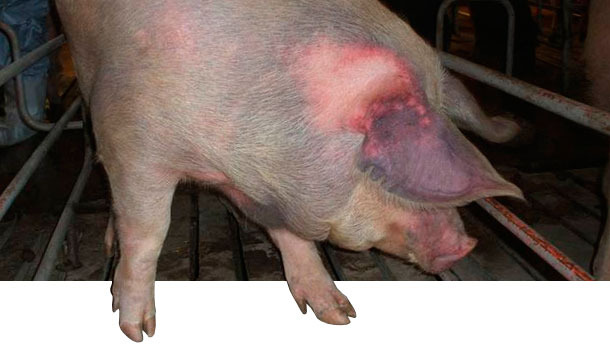
According to the article “Scientists on brink of overcoming livestock diseases through gene editing”, by Hannah Devlin, UK geneticists at the Roslin Institute in Edinburgh have been making significant progress in genetically engineering disease resistance and resilience into livestock species. Although still in its trial stages, the director at the Roslin Institute, Prof Eleanor Riley, believes that in the very near future, the farming industry will be able to save millions every year once these resistant/resilient animals are successfully introduced into the live stock population. The first and most promising experimental trial is currently producing blue ear disease resistant swine, who may be introduced into the live stock population as soon as in three years’ time. Blue ear disease can cause the effected swine to produce stunted offspring or still births, resulting in significant monetary loss in the farming industry. By identifying the gene that codes for the surface receptor, in pig cells, that the virus needs in order to bind and spread, the scientists at Roslin, were able to select and remove a small section of this gene, therefore causing the link from the blue ear virus to the pig cells to be removed entirely. This in turn means that this small genetic intervention would make the resulting swine immune to this ailment  
Image result for blue ear disease                    (pig with blue ear)         
            Furthermore, this type of genetic identification and alteration research is also under way for other significant live stock illnesses, such as the avian flu, oyster herpes, and amoebic gill disease in salmon. Geneticists at Rolsin have also begun investigating the genetic foundation for E coli and campylobacter resilience, as they are believed to be the cause of hundreds of thousands of food poisoning cases in the U.K. alone each year. Yet the public seem slow to come around to the idea of eating genetically modified animals (even though they have had no qualms with GMO crops for decades). However, once they realize the benefits genetically engineered livestock will bring to animal welfare and environmental impact mitigation, both the professionals at the Roslin institute and myself believe, the publics opinion will sway much faster in its favor.
Link to article
And for more on Blue Ear Disease

Wednesday, November 19, 2014

Viruses Are Less Effective to Genetically Diverse Populations

When a virus was allowed to spread through a group of five genetically identical mice, the virus became more effective. That is, it spread more quickly and became more severe with each mouse it infected. The same test was done, this time with the mice being genetically diverse. This time around, the virus became less virulent as it struggled to adapt to the dissimilar genomes of the mice.

The University of Utah uses this simple example to urge the owners of livestock and other bred animals to keep their genetic diversity up. A herd of genetically similar cows is the vertebrate version of a monoculture, and a single pathogen capable of killing one of them will affect all of them. Whereas a population of genetically diverse animals will cause a pathogen to kill less effectively, both on the individual level and on the level of the whole herd. The first author of the study, Jason Kubinak, believes that sexual reproduction may have evolved to keep pathogens at bay. Another hypothesis on the evolution of sexual reproduction is that it evolved to regulate the inevitable mutations that occur when DNA is replicated.


article: http://unews.utah.edu/news_releases/viruses-impaired-if-their-targets-have-diverse-genes/

Friday, March 15, 2013

Don’t Be Afraid of Genetic Modification


IF patience is a virtue, then AquaBounty, a Massachusetts biotech company, might be the most virtuous entity on the planet.


Andrew Wallace/Toronto Star, via Zuma Press

The Enviropig Scientists at the University of Guelph, in Canada, developed these pigs to produce more environmentally friendly waste than conventional pigs. But the pigs were killed because the scientists could not get approval to sell them as food.


In 1993, the company approached the Food and Drug Administration about selling a genetically modified salmon that grew faster than normal fish. In 1995, AquaBounty formally applied for approval. Last month, more than 17 years later, the public comment period, one of the last steps in the approval process, was finally supposed to conclude. But the F.D.A. has extended the deadline — members of the public now have until late April to submit their thoughts on the AquAdvantage salmon. It’s just one more delay in a process that’s dragged on far too long.

http://www.nytimes.com/2013/03/10/opinion/sunday/dont-be-afraid-of-genetic-modification.html?pagewanted=all

http://www.slate.com/articles/health_and_science/science/2012/12/genetically_modified_salmon_aquadvantage_fda_assessment_is_delayed_possibly.html


Monday, November 19, 2012

Turkey Trouble: Genetics Gone Too Far?

In light of Thanksgiving this week, here is a short article that discusses the various health problems that affect commercial turkeys. Due to the selection of large breast muscles, the turkeys on commercial farms can barely walk. They cannot even mate because their breasts are so large. Furthermore, when comparing their body size to their bone structure, there is no way that these turkeys are not in pain.


Many people do not realize that most of the qualities that we look for in certain foods are actually mutations. They have been artificially selected because we prefer those traits. However, in the case of livestock, is it morally right to breed animals with traits that cause harm to them, just for our benefit? It does not stop at livestock. Certain dogs are bred for qualities that we find desirable, but those qualities also involve health problems. I am personally a little put off by the fact that turkeys and chickens on commercial farms are prone to having heart attacks because their hearts cannot handle the work necessary to pump blood throughout their super-sized bodies. It's really something to think about.