Showing posts with label implant. Show all posts
Monday, November 25, 2019
A Step Toward Putting Batteries in Humans
Ryota Iino is a Japanese researcher with the Institute for Molecular Science of the National Institutes of Natural Sciences. He and the other researchers focused on the V1 rotational motor found in the membrane of healthy cells. The motor acts as a pump, moving sodium ions through the cell membrane. They used an advanced probe to observe a single molecule from the bacteria Enterococcus hirae (above). They used the high-resolution images to develop an understanding of how the motor turns chemical energy into mechanical energy. They found that it works closely with another motor complex called Vo to convert the energy of the sodium ions into electrochemical potential energy similarly to how electric eels generate electric energy.
With further research, Ryota Iino plans to further understand the complexity of the energy conversion. If they are able to learn enough about the motor complex, he believes it could be possible to design an implant that could be put in electric eels of even humans to generate energy.
Labels:
Bacteria,
cell membrane,
energysource,
implant,
molecular motor,
V1,
Vo
Wednesday, November 23, 2016
Contraception Implant with Warning
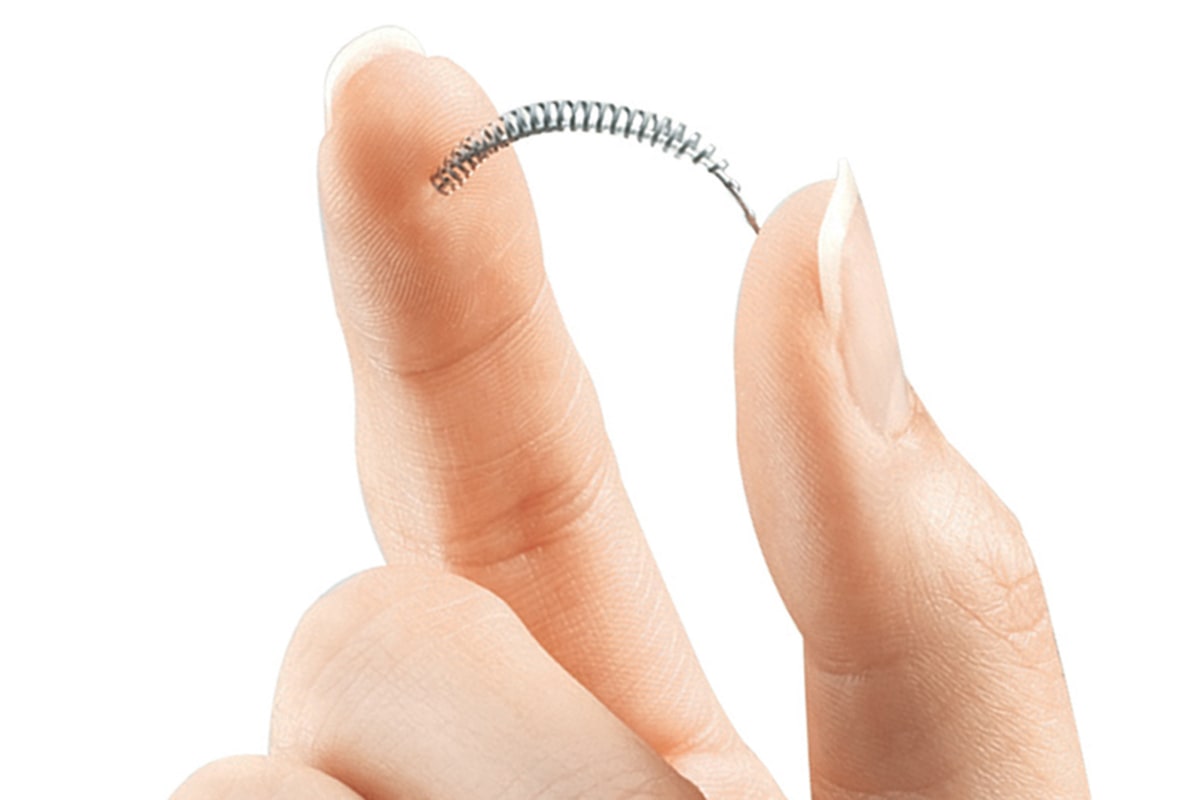
An alternate form of sterilization without using general anesthesia, is produced by Bayers, and is called Essure. This implant consists of two coils that is placed in the fallopian tubes. It is designed "to provoke an inflammatory response that causes scar tissue to form and block the tubes a process that can take three months."
During the conduction of this study, there was no control variable and is now known to cause damage when placed. When this is placed it is known to puncture the fallopian tube and the uterus. It can travel into the abdomen and pelvic cavity. Only possible way to remove if there is damage, is by surgically removing it. A disadvantage to having damage done, is that some doctors do not even know how to remove it once it is placed. The company Bayers claims that the damage is due to not having proper medical surgical skills, it is not Essence.
Link: http://www.nytimes.com/2016/11/21/well/bayers-essure-contraceptive-implant-now-with-a-warning.html
During the conduction of this study, there was no control variable and is now known to cause damage when placed. When this is placed it is known to puncture the fallopian tube and the uterus. It can travel into the abdomen and pelvic cavity. Only possible way to remove if there is damage, is by surgically removing it. A disadvantage to having damage done, is that some doctors do not even know how to remove it once it is placed. The company Bayers claims that the damage is due to not having proper medical surgical skills, it is not Essence.
Link: http://www.nytimes.com/2016/11/21/well/bayers-essure-contraceptive-implant-now-with-a-warning.html
Tuesday, April 14, 2015
Need a Heart Transplant? Just Grow One!
In a search for a method of heart transplant that would eliminate the need for anti-rejection drugs, scientists are working to grow a heart from stem cells. This sort of a medical breakthrough could revolutionize the way modern medicine operates.
Researchers take a fully functioning heart and remove all cells until they are left with a "ghost heart" or "scaffolding". Stem cells are then introduced to this framework and a new heart is grown. After being exposed to blood flow for 20 days, this new heart begins to contract again at a normal rate.
This new technology could be used to replace parts of a heart damaged by a heart attack, or even possibly the entire organ in some patients. The heart is not the only organ that has been grown artificially. Research is also being done with other organs such as the liver. This new technology could be the future of medicine, eliminating the need for traditional transplant and the plethora of anti-rejection drugs. If a patient receives a heart grown directly from his/her stem cells, problems with the implant are less likely.
Sunday, November 16, 2014
Controlling Gene Expression by Thought
Two researchers, Marc Folcher and Martin Fussenegger, found a way for people to control their genes. Until now, genes were regulated by naturally made molecules, which assisted in the translation of genes into proteins. However, these two researchers are modernizing gene expression- they found a way to allow an individual to control their own gene expression by thought. Recently, an experiment was conducted that has never been accomplished before. It has been found that certain brainwaves enable specific genes to become expressed, and therefore Folcher and Fussenegger electrically transferred brainwaves to a gene network. Different brainwaves were able to activate or deactivate certain genes. This type of control came about because of a game called "Mindflex;" in this game, an EEG of the player's brainwaves is taken, and the player is able to move the pieces on the game board with their mind by changing his or her thoughts (i.e. level of concentration).
a chamber attached to an infrared light
In the experiment, a headset similar to the one in Mindflex is used, and the brainwaves are projected onto an electromagnetic field. The electromagnetic field provides an electrical current. A light is directly attached to an implant, and when it lights up, a certain protein can be synthesized from the cells that were modified in a chamber. A close-to infrared light was used because it is completely safe, yet it is able to reach the tissues of the organism it is acting upon. It can also monitor the activity of the implant. The easiest gene to use this method for is called SEAP, which is a gene taken from the placenta. This is the easiest gene to use because it uses passive transport to diffuse from the chambered culture to the implant. This protein was controlled by an individual, who caused a normal amount of SEAP to be present in mice when he or she was intently concentrating, but the SEAP level increased when he or she was in a more relaxed state. The user was therefore able to control the activity of the (nearly) infrared light.
As for the future of protein control, Fussenegger hopes to one day use this system to help patients battle diseases of the nervous system. If the problem-causing molecule is detected, this method may be used to inhibit the production of it, or increase the production of another, more helpful molecule.
Article: http://www.sciencedaily.com/releases/2014/11/141111111317.htm
Supporting article: http://www.theguardian.com/science/2014/nov/11/mind-control-device-alter-genes-mice
As for the future of protein control, Fussenegger hopes to one day use this system to help patients battle diseases of the nervous system. If the problem-causing molecule is detected, this method may be used to inhibit the production of it, or increase the production of another, more helpful molecule.
Article: http://www.sciencedaily.com/releases/2014/11/141111111317.htm
Supporting article: http://www.theguardian.com/science/2014/nov/11/mind-control-device-alter-genes-mice
Subscribe to:
Comments (Atom)