Showing posts with label genetic geneaology. Show all posts

Wednesday, April 6, 2022

A Family Tree with over 27 Million Ancestors has Been Discovered


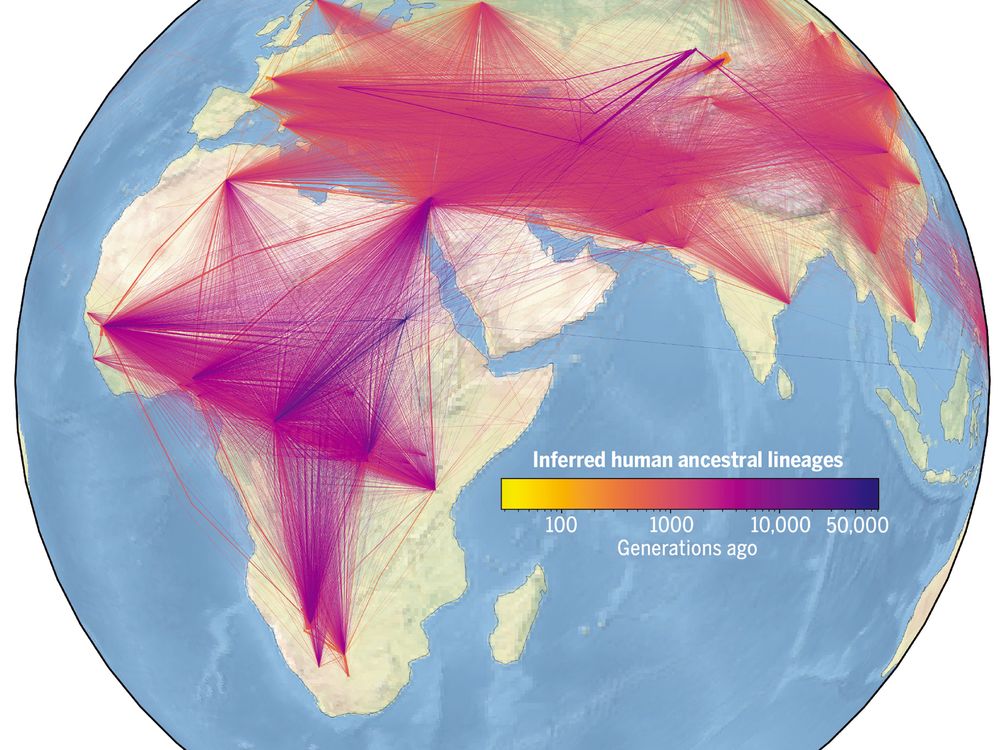
A Smithsonian article that was just published announced that the largest family tree has been discovered, and it contains over 27 million ancestors. By using genomes from ancient ancestors as well as modern genomes, scientists were able to reconstruct the tree based on geographic location. Because there were many difficulties for researchers to be able to decipher how to combine different genome sequences from multiple databases, this newly developed study has changed the world of genetics.

The study, primarily conducted by Anthony Wilder Wohns, discusses the methods and results from constructing the tree, as well as the difficulties going into working on this research. The introduction mentions how diverse genomic datasets are and working with several of those datasets can cause errors when dealing with complex patterns. 

The results of the study were successful in terms of the intention of the study. They were able to used over 3000 modern genomes and a few ancient ancestor genomic sequences to compile 27 million haplotype fragments as well as over 200 million ancestral lineages. By using the ancient samples, researchers were successful in identifying individuals as well as populations which created lines of descendants. They were also able to use geographic location discussing evolution and the out-of-Africa theory, which describes that the earliest humans came from the African continent, and eventually spread out over time. To conclude the study, researchers wrote that this is a great start to investigating genomic sequences and discovering more information about evolution, specifically in humans.

While the study was successful and provides key information in the world of evolution and genetics, there is still a lot of additional research to be done. The tree suggests that earlier humans may have come to North and South America earlier than expected, as well as similar interesting information about Oceania humans. The scientists who worked on this discovery intend to use it to help other areas of science, like in the medical field. 

When I saw this article, I was immediately drawn to it because of how many ancestors the researchers were able to connect. The world of technology and its work in genetics is remarkable and the idea that we can use geography and genomic sequences to help understand evolution and our lineage is amazing. Since this is fairly new, I expect more information to arise in the coming weeks as more researchers analyze the results seen in the study. I hope that this leads to more discovery in terms of the biological studies and that we can learn a lot of valuable information about our past.

Related Articles:

More Information Regarding the Study

Earlier Research Using Genetic Sequencing to Construct a Family Tree


Thursday, March 17, 2022

Genetic Genealogy and DNA Help Solve 34-Year Old Murder Case


An article by The San Diego Union-Tribune discussed the murder of Diane Dahn, a woman who was 29 when she was brutally stabbed in 1988. She was left for dead in her apartment, and while investigators kept investigating the case for decades to come, it was not until recently with new genetic techniques that a suspect was able to be determined. 

Before genetic genealogy came into play for Dahn's case, DNA techniques were used as early as the 2000s. There were several pieces of DNA that were able to be used from Dahn's fingernails as well as a hair that was found in her hand, but when entered into the national databases, there were no matches. It was not until May of 2020 that genetics took over and really helped aid the investigation.

Genetic genealogy uses atDNA, also known as autosomal DNA in order to identify how closely related certain individuals are to each other. This type of DNA is inherited in all individuals and can be seen in both males and females. While the single nucleotide polymorphisms are harder to detect using forensic samples, technology is advanced enough to obtain information from small or degraded samples. The longer a segment is shared between two individuals, the more closely related they are. This helps establish family trees and helps piece together these kinds of cold cases.

Through the use of several genealogy websites, investigators were able to identify relatives of the suspect in order to find possible matches. These websites allowed law enforcement to see open DNA profiles in order to biologically look at the DNA and make certain matches for relatives. Family trees, or pedigrees, were created based on the matches found through the websites and 1,300 relatives and 9 pedigrees were able to be created based on the results of the unknown suspect. This led to finding the suspect's children, and when a paternity test was done, they found the suspect: Warren Robertson, a man who lived in the same apartment complex as Dahn, but had died in a fire in 1999.

Based on the success of this case, as well as 5 others San Diego have solved, genetic genealogy is on the rise and provides good results in order to help locate a suspect or provide more information based on DNA profiles found at a crime scene. I think while it is a tedious and difficult process, the success rate of genetic genealogy and the information being discovered is amazing and helps in the field of forensic science. Forensic biology is on the rise as DNA and its advancements provide helpful information. I believe these biological techniques are here to stay and aid in law enforcement investigations which is a win-win in terms of science and criminal justice.

Related articles:

Dead Convict Identified as Oregon Serial Killer From the 1980s

The Future of Genetic Genealogy

Sunday, November 29, 2020

Idaho Police Reopening Cold Cases to Solve With Genetic Geneaology

     In the article posted by Post-Register, it was mentioned that the police force in Idaho will be putting efforts into improving their forensic services. More specifically the forensic service they are putting money into is a new technique called forensic molecular genealogy. The Idaho police force intends to use this technique to solve previously closed cold cases. The usual problem that is encountered with the DNA database is that the criminals DNA is not on file; however with genetic genealogy DNA samples are compared to samples provided for open-access and criminals samples. Therefore, there would be a higher probability that the criminal could be found. I found this article to be very well-written, and I look forward to hearing whether they were able to solve any of the cold cases they reopened. In my opinion I believe the use of genetic genealogy in the forensic field is very novel. However, I find the security behind open-access DNA samples to be suspicious, as it is speculated the information donated may be sold to other companies.