Showing posts with label chitin. Show all posts

Tuesday, December 2, 2025

Fungus Food: CRISPR turns a simple fungus into a meatlike protein with a smaller environmental footprint

    As the demand for sustainable food continues to increase, scientists are exploring alternatives to traditional animal proteins (which currently amount for nearly 14% of global greenhouse gas emissions). Mycoprotein, developed from fungi, has come to be a promising solution due to its meat-like texture and smaller environmental impact. One of the leading sources, Fusarium venenatum, is already approved for consumption in several countries. However, its thick cell walls make it difficult to digest in addition to it being costly to produce.

    To address these challenges, researchers at Jiangnan University in China used CRISPR gene-editing technology to improve both the nutritional value and efficiency of Fusarium venenatum. By taking away two specific genes related to chitin production and metabolism, they created a new strain titled FCPD. The thinner cell wall significantly improved digestibility, while metabolic changes allowed the fungus to produce protein much more efficiently. As a result, the modified strain used 44% less sugar and produced the same amount of protein 88% faster than the original version. There was also no foreign DNA introduced.

                                                                        Picture of Fusarium venenatum.

    Past improving efficiency, the environmental benefits of FCPD were dramatic. A full life-cycle analysis across six countries with different energy systems showed that FCPD consistently produces fewer greenhouse gas emissions than conventional mycoprotein, with reductions of about 60%. In comparison to animal protein, the results were even more striking: FCPD needed 70% less land and caused 78% less freshwater pollution than chicken production in China. This breakthrough highlights how gene-edited foods could play a major role in feeding an increasing global population while crucially reducing strain on the planet.

https://www.sciencedaily.com/releases/2025/11/251121082049.htm 

https://www.sciencedirect.com/topics/agricultural-and-biological-sciences/fusarium-venenatum 

Monday, February 26, 2024

Ancient Phytoplankton Sailed The Great Sea

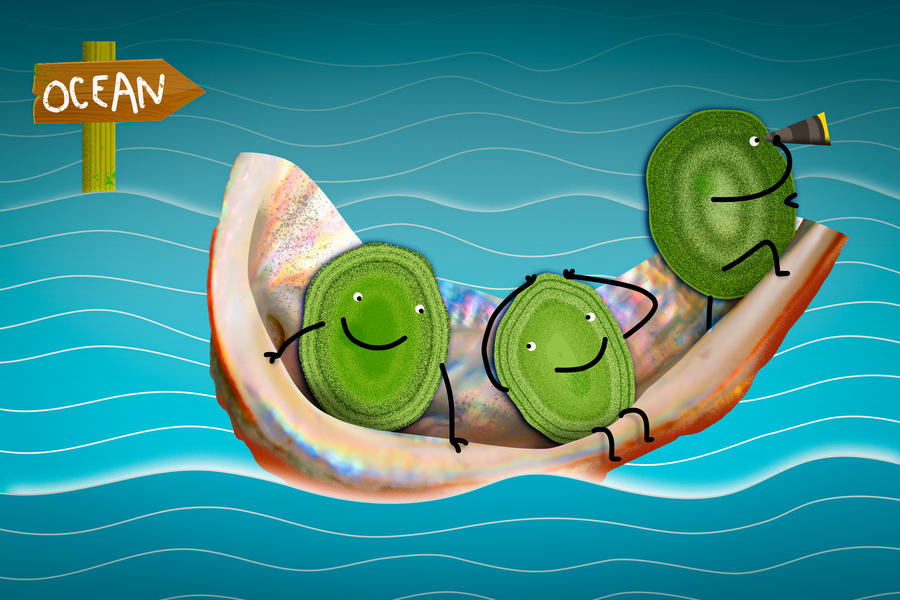
Billions of phytoplankton use Earth's sunlight to absorb carbon dioxide from our atmosphere. In the article written by the Massachusetts Institute of Technology, they give insight into the genetic evolution of our sun-loving little friends. Prochlorococcus is one of the most abundant free-floating plankton in our oceans today. Ancestors never were out in the great open, they resided near coastlines where food and resources were plentiful. Much like boats, these ancestor plankton anchored themselves to small pieces of chitin floating throughout the water and out to sea. The chitin provided all that they needed, but once far out in the ocean these little friends developed into the free-floating phytoplankton we know today. Without this evolutionary change, our planet would not be the same as we know it. They completely changed the earth's biosphere. This is because these prochlorococcus can go through photosynthesis in areas with little light and can mix other carbon-capturing strategies. When researchers were studying these traits, they came across several genes that allowed the phytoplankton to break down chitin. This carbon-rich material comes from breaking down the shells of the arthropods they carried on. 


I enjoyed this article because it was written for a reader with a limited understanding of the topic originally. We usually do not think about things we can't see, especially things that many do not know exist. Phytoplankton are known to absorb the same amount of carbon that terrestrial forests do. These small, microscopic green friends shape our world not by absorbing carbon, but because they are a main part of the aquatic food web. They produce more than half the oxygen we breathe. Remember this next time you swim in the ocean!

Sources:

McCullough D. 2019 Aug 8. Plankton: Small Organisms with a Big Role in the Ocean - Ocean Conservancy. Ocean Conservancy. https://oceanconservancy.org/blog/2019/08/09/plankton-small-organism-big-role/.

Chu J. 2023 May 11. Like ancient mariners, ancestors of Prochlorococcus microbes rode out to sea on exoskeleton particles. MIT News | Massachusetts Institute of Technology. [accessed 2024 Feb 26]. https://news.mit.edu/2023/ancestors-prochlorococcus-microbes-chitin-0511.