Showing posts with label butterfly. Show all posts

Sunday, August 8, 2021

First US Case of Human-Led Insect Extinction Confirmed by DNA From 93-Year-Old Butterfly

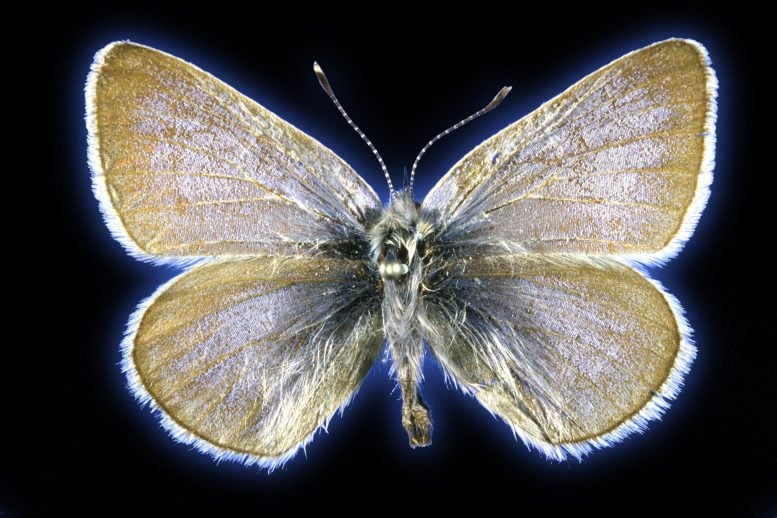
 93-Year-Old Xerces Blue Butterfly Specimen

 The Xerces blue butterfly (Glaucopsyche xerces) is thought of to be the first insect species being drove to extinction by humans, with the rapid urbanization in the San Francisco area in the 1940s playing a role. There has been a lot of question over if this butterfly was in fact a separate species or just a sub-population of a common butterfly but researchers have taken a specimen from a museum collection and analyzed its DNA and found that is was, in fact, its own species. Researchers were able to extract a piece of a specimen's body and sample and treat the tissues in order to separate the DNA and analyze it. While the specimen was over ninety three years old and DNA does degrade over time, its stability helps slow down the degradation. 


Researchers continue to analyze DNA of extinct species when possible for a multitude of reasons. The first is the possibility of bringing extinct species back to life. While this seems like a good reverse of damage that was done, they do argue conservation of still living species should be the focus. Another is to see what we can learn from them to further our current conservation efforts. This study specifically shows the relationship between humans and insects, the latter of which is experiencing a high level of extinction which could affect all ecosystems severely. This also shows the importance of museum collections and other specimens for future use and study.


 https://scitechdaily.com/first-us-case-of-human-led-insect-extinction-confirmed-by-dna-from-93-year-old-butterfly/

  https://royalsocietypublishing.org/doi/10.1098/rsbl.2021.0123


Monday, March 18, 2013

Solving the Puzzles of Mimicry in Nature

A New York Times article discusses the recent advances in the understanding of mimicry occurring in nature. This study comes from a similar location to that of Charles Darwin's studies: Brazil. The main individual of study is the butterfly. Mimicry is when an population begins to adapt similar colors, patterns and overall looks to another. In butterfly species, a non-poisonous population will begin to mimic the colors and patterns of poisonous populations. The benefits of this natural occurrence are numerous and help protect the non poisonous populations from becoming prey. Not only were non-poisonous populations mimicking poisonous ones, but poisonous species began mimicking each other. Mueller theorized that in this fashion, the butterflies formed a sort of "army" where all other species would know they were not the be eaten.

Until recently, however, how mimicry occurred was unknown. That was until Mueller proposed that mimicry stemmed from two sources: independent evolution or gene swapping. The genes controlling the causes of mimicry have been recently identified. Using this knowledge, it is safe to say that source of mimicry comes form both mechanisms working cooperatively. Although interbreeding is rarely seen between different populations, due to the extreme advantages of mimicry, one individual can spread the gene through the population quickly.

This mimicry is crucial to the survival of butterfly species in Brazil.

Monday, April 2, 2012

Red Butterfly Patterns All from One Gene

In a study in ScienceDaily, Smithsonian scientists in Panama have discovered a single gene that codes for all variations of red wing patterns in Heliconius butterflies. By combining old techniques with new, this fascinating new information was discovered; one gene for all red coloration in their wings. The only thing that differs, making different patterns of red, is the way this gene is regulated. Scientists accomplished this by looking at genes through different screens of butterflies with red wing patterns, and butterflies without them. They found such a gene that matched up every time to where the red pigment occurred on the wings.


 The interesting part is that this same gene is also one that is already known to code for assisting in eye development for other animals. It’s known as the Optix gene. This is a spectacular discovery because genetic variations in the tropics have always been a mystery to scientists. Now that they know one gene can cause some many variations, these scientists believe that the diversity of our world may be coded by far less genes than originally believed.