Showing posts with label High-resolution microscope. Show all posts

Monday, January 30, 2017

Scientists find 'oldest human ancestor'


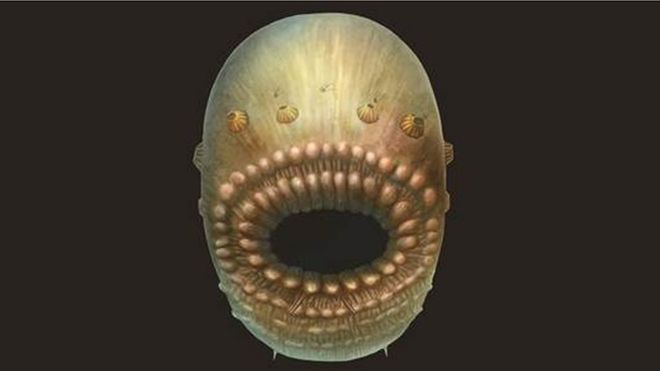
Researchers have recently discovered the earliest known ancestor of humans. They have claimed that this fossil traces back to over 540-million years ago, and was well preserved. This microscopic sea animal is the earliest known to the evolutionary path that led to a fish and eventually to humans. The scientist behind this say that Saccorhytus is believed to be the most primitive of the deuterostome family. Researchers concluded that Saccorhytus was about a millimeter in size, and is believed to have burrowed itself between grains of sand on the sea bed. Saccorhytus was also covered with a thin like, flexible skin and muscles, leading scientist to conclude that it moved by contracting its muscles and making it twist and turn. The researchers say that its most striking feature is its immense mouth, relative to the rest of its body. Scientist say that it probably ate by sucking food particles, or even other small microscopic creatures. 
I believe this is an amazing find for scientist because it is the oldest deuterostome; surpassing the other recently discovered deuterostome, dating about to 520-million years ago. What I found interesting is that the researchers were unable to find any evidence that the animal had an anus, which suggests that it consumed food and excreted from the mouth. As I can see,  this not only gives us understanding into the very first stages of the evolution that led to the fish, but to us. 

http://www.bbc.com/news/science-environment-38800987
http://www.nature.com/nature/journal/vaop/ncurrent/full/nature21072.html

Wednesday, November 7, 2012

Size Does Matter in Sexual Selection, at Least Among Beetles

According to Science Daily, at the University of Sweden the Cincinnati there has been a discovery among seed beetles. The male genitals among these beetles have proven more biological diversity. This has been proven through a lot of research using specific techniques. This mechanism was shown in a study published in a journal Current Biology.  The seed beetle known as Callosobruchus maculatus. These beetles that mate among females has an involvement of more than one individual beetle. Among the male beetles there is a competition over the fertilization of the female eggs. The male’s copulatory organ can possibly determine which of the several males will fertilize more of the eggs.  

[caption id="attachment_5698" align="aligncenter" width="300" caption="A pair of seed beetles demonstrating sexual selection."][/caption]

 There is a competition to produce offspring as the driving force in evolution. Because of this there is a strong diversity of shapes and sizes of male sexual organs. New species can be formed among the beetles through the different shapes and sizes of the male sexual organs. By breeding the beetles which had longer genital spines there were greater results of more offspring compared to beetles with smaller spines. The spines were further looked into by a doctor from Sweden. Dr. Polak used a micro-scale laser surgery. In his experiments he is most known for this laser system which is quite precise. Using this he was able to be make microscopic changes to the insects’ bodies.

[caption id="attachment_5699" align="aligncenter" width="448" caption="English scientist Charles Darwin originated the theory of evolution by natural selection, famous for Origin of Species and The Descent of Man."][/caption]

The insects altered through both the methods were then observed throughout a competitive mating process. The longer genital spines were more successful in fertilization. The seminal fluid was tracked as well through high-resolution radioisotope labels. This was shown to enter the female’s body much quicker after mating with long-spine males than the shorter spine beetles. This has to be one of the most interesting articles I have read yet. It’s strange how beetles could actually be considered to let size matter. Among humans it is constantly said that size is not a major issue, but still there is commotion among other people. The idea of these beetles spines looked into can be beneficial possibly among other insects? Who knows, but as far as we know this is pretty rare!