Showing posts with label "reproduction". Show all posts

Tuesday, November 11, 2025

Genes, Reproduction, and the Price of Longevity, Blog#3


 Genes, Reproduction, and the Price of Longevity
Evgeniya Staleva
BIOL- 2100-001- Genetics
Professor Guy F. Barbato
November 11, 2025

    The article "Genes That Boost Fertility Also Shorten Our Life" presents new evidence in support of George Williams's 1957 theory of antagonistic pleiotropy and the idea that certain genes enhancing fertility in youth may have harmful effects later in life, contributing to aging. Using data from the UK Biobankwhich includes information from half a million people, researchers Jianzhi Zhang and Erping Long identified hundreds of genetic variants that increase fertility but are also associated with shorter lifespans. In addition, these fertility related variants were almost five times more likely to affect longevity compared to unrelated genes. One interesting discovery was that people born after 1965 tended to carry more of these fertility boosting variants than those born in 1940. This suggests that, even today, evolution continues to favor reproductive success. And although advances in medicine, health, and nutrition have extended human life expectancy, the underlying genetic trade- offs remain detectable.


    The study offers a fascinating look at how evolutionary biology intersects with modern genetics. It challenges the idea that aging is simply a defect in our biology, instead suggesting that aging results from evolutionary trade- offs. I find it both intriguing and somewhat ironic that the very genes that help us reproduce and ensure the survival of our species may also work against us later in life. It is a reminder that evolution doesn’t aim to maximize how long we live, but instead favors traits that improve our chances of reproducing.

Sources

https://www.nytimes.com/2023/12/08/science/fertility-genes-lifespan.html

https://pmc.ncbi.nlm.nih.gov/articles/PMC3220400/?utm_source=chatgpt.com

https://www.mrc-epid.cam.ac.uk/blog/2021/08/04/new-genes-longer-reproductive-lifespan/?utm_source=chatgpt.com

Sunday, August 6, 2023

PCOS Genetically Linked

 PCOS is thought to be produced by an autosomal dominant inheritance pattern, and there is evidence to support this theory in the form of family clustering of instances. The investigations, on the other hand, have been hindered by things like limited sample numbers, statistical mistakes, and diagnostic disparities. Based on the findings, it appears that polycystic ovary syndrome is caused by a fundamental genetic defect in the synthesis of ovarian androgens, which then interacts with environmental conditions or other factors that lead to hyperinsulinemia. The suspected PCOS gene is connected to a region on chromosome 19p13.3, which is located close to the gene for the insulin receptor. Additional molecular genetic techniques offer the potential to provide light on the pathogenesis of polycystic ovary syndrome (PCOS).

Polycystic Ovary Syndrome (PCOS) is a complex trait with an oligogenic basis, with genetic factors playing a role. Environmental contributions are crucial, as there are no universally accepted genes important in PCOS etiology. Two approaches are used to identify a genetic locus: association studies and linkage studies. Genetic abnormalities affect signal transduction, steroid hormones, insulin action, energy homeostasis, and chronic inflammation.


https://www.sciencedirect.com/science/article/pii/S1521693404000926?casa_token=Ah_f1TtZaJAAAAAA:Wd4tE3pPIW2sQMJkkWf4IHLk8Sb2eMLZP_AtdXdtKXY4gKaKnL_-g2ZivVprRYKZSdtVWHsFB8pq

https://www.ncbi.nlm.nih.gov/pmc/articles/PMC2776334/

Sunday, September 22, 2019

Gene In Worms Promote Age and Reproduction, but Supress Immune Response

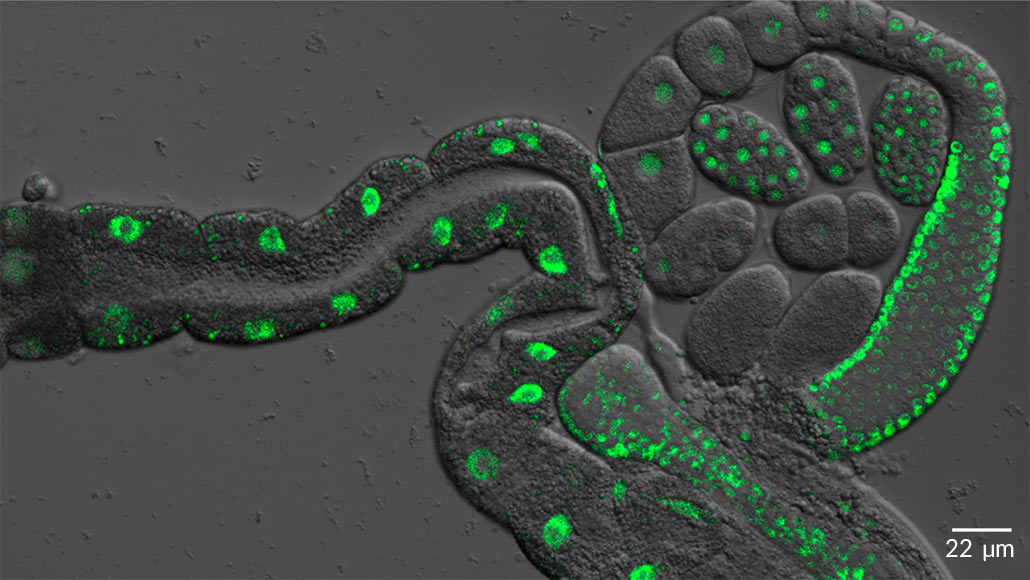
A study is being done by geneticists to see how a gene in worm DNA is affecting the worm's lives. First, they noticed that the worms were producing more offspring and were living longer unless exposed to a disease. They recognized the gene, TCER-1 as responsible for producing the protein that has this affect. At first, they though the gene would increase immune response along with reproductive capabilities. They observed the complete opposite. What was observed was that the worms with the gene produced more offspring but fought off diseases worse. When exposed to Alzheimer's disease protein, which paralyzes worms, worms with the gene survived nearly 1/3 of the time that worms with the genes did. Although, the gene made it possible for sick worms to produce healthy offspring.

protein microscopy

Recently, a similar gene was discovered in humans. While not a worry at the moment, scientists say it is a "warning bell"(Saey). Particularly this could affect anti-aging therapies as some can cause unexpected frailty. Personally, the research is important and is something humans need to keep an eye on. It is especially important now that humans are living longer and longer and as more resistant diseases are beginning to emerge.


https://www.sciencenews.org/article/gene-may-help-worms-live-longer-not-healthier
https://www.nature.com/articles/s41467-019-10759-z