Developmental stuttering is a common speech disorder that affects over 400 million people worldwide and is recognized by syllable repetitions, sound elongations, and speech blocks. Although many children recover, a fraction continue to stutter into adulthood. A groundbreaking study led by Dr. Hannah Polikowsky at Vanderbilt Genetics Institute connects the dots of the heritability of stuttering.
Polikowsky's study contained large-scale genome association analyses on over one million subjects. By using ancestry stratification and metal-analytic approaches, the researchers were able to identify 57 unique loci associated with stuttering risk. These findings validate the role genetics has in developing a stutter and reveals the overlap it has with neuro-developmental and neuropsychiatric traits such as autism and ADHD.
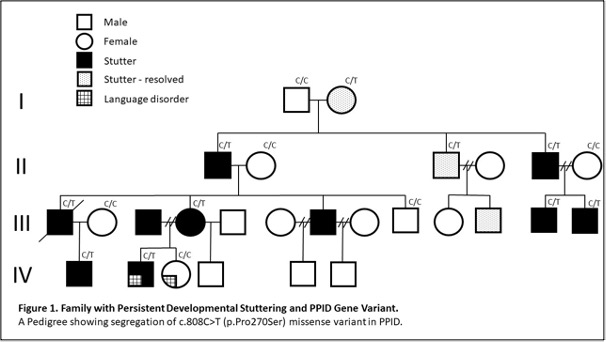
This study also highlights sex-specific effects, being that the persistence of stuttering is majorly higher in males. Researchers were able to identify loci with different effect sizes by analyzing sex-stratified GWAS. Furthermore, the researchers uncovered enrichment for genes that play a role in axon guidance, neurotransmitter signaling, and cortical brain regions associated with speech and motor control.
This study represents a major step forward in furthering the understanding of the biology of stuttering. This study reveals the polygenic nature of stuttering and how it links to other neuro-developmental processes.
Sources:
Polikowsky et a.l (2025). Genome-wide association analyses of developmental stuttering in over one million individuals. Nature Genetics, 57(12), 1785–1797. https://doi.org/10.1038/s41588-025-02267-2
Hildebrand, M., & Morgan, A. (2024, Spring). Unlocking the genetics of stuttering. Stuttering Foundation. https://www.stutteringhelp.org/content/unlocking-genetics-stuttering
No comments:
Post a Comment